
Corporate Event Catering: What to Know Before You Book
The first time a corporate event catering bill truly scared me, I was three years into planning meetings and thought I had the numbers nailed. We had a two day leadership summit for 180 people, a lovely hotel ballroom, and a food and beverage minimum I was sure we would clear without trying. We did clear it. What I had not done was the math on everything that sat on top of it. The service charge, the tax on that service charge, the bartender fees, the chef attendant fees for a carving station somebody added in week three. The final invoice landed almost a third higher than the number in my head, and I had to walk into my director’s office and explain why.
I have been a Certified Meeting Professional for a long time now, and I still think about that summit every time I sit down with a new caterer. Corporate event catering is one of the few parts of a program that every single attendee experiences, judges, and remembers. People forget the keynote title. They do not forget a cold lunch, a two hour wait at the coffee station, or the colleague with a nut allergy who ate nothing but a dinner roll all day.
So this is the conversation about corporate event catering I wish someone had with me early on: the real decisions and contract details that decide whether your catering supports the event or quietly sabotages it.
Start Corporate Event Catering With the Purpose, Not the Menu
Before I look at a single menu, I ask the client one question: what is this meal supposed to do?
A working lunch during a board meeting has a job. It needs to be quiet, quick, and easy to eat while someone is talking through a slide deck. A welcome reception has a completely different job. It needs to get strangers moving around the room and talking to each other. A client appreciation dinner is about making guests feel valued, and the pacing of the courses matters as much as the food on the plate.
When you know the job, half the decisions make themselves. Flaky pastries and saucy dishes are a poor fit for people holding laptops. A seated plated dinner is the wrong call for a networking event, because once people sit down they stay with whoever they sat next to. Heavy carbohydrates before an afternoon of strategy sessions will cost you attention in the room by two o’clock.
Write the purpose of each meal function in one sentence and bring that sheet to every caterer conversation. It keeps your corporate event catering plan focused on what works instead of what looks impressive.
How Venue Rules Shape Your Corporate Event Catering
Here is something newer planners often learn the hard way: your venue choice usually makes your catering choice for you.
Most hotels and many conference centers require you to use their in house catering. Read the banquet policies closely and you will often find language that bans outside food and beverage completely, with fees or removal if anything is discovered. Some make a narrow exception for a specialty cake. That means the moment you sign a hotel contract, you have also signed up for their kitchen, their pricing, and their service charge.
Unique venues are a different story. Museums, lofts, rooftops, wineries, and corporate campuses often have no kitchen at all, or they keep a short list of approved outside caterers. As Small Market Meetings points out in its planner guide to catering, the venue is one of the biggest factors in choosing a caterer, and unusual spaces frequently require bringing in an outside team. That gives you more freedom, but it also adds a layer of logistics. You will need to ask:
- Is there a working kitchen, or will the caterer need to bring warming equipment and set up a prep area?
- Where is the loading dock, and what are the delivery windows?
- Who supplies tables, linens, glassware, and trash removal?
- Does the venue charge a kitchen use fee or a buyout fee for outside caterers?
- Are there power limits that could trip a breaker when six chafing dishes and a coffee urn plug in at once?
That last one is not hypothetical. I once lost power to half a buffet line in a historic building twenty minutes before lunch, and we only recovered because the caterer had brought a backup after spotting the circuit problem during a walkthrough.
Reading a Corporate Event Catering Contract Like a Planner
This is where corporate event catering budgets go sideways, usually because of a few lines of fine print.
The Food and Beverage Minimum
Hotels protect their banquet revenue by setting a minimum amount you agree to spend on catered food and drink. Stova’s guide to F&B minimums makes a smart point here. Planners tend to fight the minimum down even when they know their program will exceed it, and in doing so they miss the chance to use that extra spend as leverage. If you know you will blow past the minimum, say so, and ask for something in return. A complimentary meeting room, a hosted coffee break, upgraded linens, or a discount on audiovisual can all be on the table.
The other side matters too. If you fall short of the minimum, you pay the difference anyway. Groups whose attendance drops can end up paying for food nobody ate.
Service Charges, Gratuities, and the Plus Plus
When a menu says a lunch is $48 “plus plus,” that means plus service charge and plus tax. Service charges commonly run somewhere in the low to mid twenties as a percentage, and in many places the tax is applied to the service charge as well, not just the food. Hospitality Net’s look at a decade of change in hotel catering gives a clear example: a $20,000 minimum can easily turn into a cash outlay of $27,000 or more once those charges are layered on.
Two things I always do:
- Build my budget on the fully loaded number, never the menu price.
- Ask in writing what portion of the service charge actually goes to the staff. A service charge is not automatically a tip. Some of it may be an administrative fee kept by the house. If it is not a gratuity, I want the contract to say so, so my client can decide whether to tip the banquet team separately.
Do not be shy about asking. It is your client’s money.
The Fees Nobody Mentions Up Front
Look for line items such as:
- Labor charges for groups under a minimum headcount
- Bartender and cashier fees, often charged per bartender per set number of hours
- Chef attendant fees for action stations
- Room flip or reset fees if a space has to change from theater style to rounds
- Cake cutting, corkage, or specialty equipment charges
The IEEE Events food and beverage planning page lists several of the clauses worth checking, including server and bartender minimums and alcohol policy. It also mentions that some hotels will offer a discount when banquet event orders are submitted well in advance.
Guarantees, Overset, and the Headcount Game
Your guarantee is the number of guests you commit to paying for. Most venues want it about three business days before the event, though some ask for five or more, and once you submit it you can usually go up but not down. You will be billed for the guarantee or the actual number served, whichever is higher.
Most kitchens also prepare a small overset above your guarantee, commonly in the range of 3 to 5 percent, to cover surprise guests and late dietary requests. Ask exactly what the overset is, whether it covers food or just place settings, and how extra plates beyond it are charged.
Now the part that takes experience. Registration numbers are not attendance numbers. People register for a three day conference and skip the closing breakfast. I track show rates by meal function, not by event. In my data, the last breakfast is usually the weakest and the opening reception the strongest.
If you have no history with a client, start a simple spreadsheet logging registered, guaranteed, and actual counts for every meal. Within two or three events, your corporate event catering guarantees will be based on evidence instead of fear.
Choosing a Corporate Event Catering Style That Fits the Agenda
Each service style has a cost, a time footprint, and a social effect. Here is how I think about the main options.
Plated service feels elegant and keeps the room under control, which makes it ideal for award dinners and programs with speakers during the meal. It requires more servers and a precise entrée count, so you will need meal choices collected ahead of time.
Buffets offer variety and handle dietary needs well, since guests can choose for themselves, and there are plenty of buffet catering ideas that suit corporate groups. The catch is time. A single sided buffet line for 300 people is a traffic jam. Ask for double sided lines, or one line for every 75 to 100 guests, and make sure servers are refreshing platters rather than topping up half empty trays.
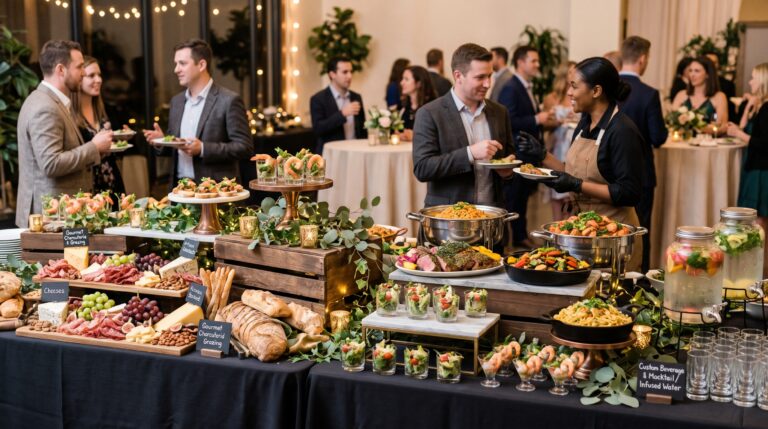
Food stations are my favorite for receptions and networking functions. They pull people around the room, create natural conversation points, and work well for mixed dietary needs. They can get expensive fast if you add chef attendants at every station.
Boxed or grab and go meals are underrated for working sessions, site tours, and tight agendas. Done well, with real food rather than a sad sandwich, they keep the schedule intact.
Family style service puts large platters on each table. It feels warm and works beautifully for team dinners.
Whichever style you choose, build the clock around it. A plated three course lunch rarely takes less than an hour. If your agenda only gives lunch forty five minutes, either change the style or change the agenda.
Dietary Needs and Allergens in Corporate Event Catering
Today it is normal for a meaningful share of attendees to note some kind of dietary need. In corporate event catering, handling that well signals a professional program. Handling it poorly can put someone in the hospital.
In the United States, the FDA recognizes nine major food allergens: milk, eggs, fish, crustacean shellfish, tree nuts, peanuts, wheat, soybeans, and sesame. Sesame was the most recent addition, formally added at the start of 2023 under the FASTER Act. You can read the details on the FDA’s page about sesame becoming a major food allergen.
My process looks like this:
- Ask the right question at registration. Do not just offer checkboxes for vegetarian and vegan. Include an open text field and separate allergies from preferences, because a caterer handles them very differently.
- Send the caterer a real list, not a tally. Names, the specific need, and which meal functions each person is attending.
- Ask how the kitchen prevents cross contact. Separate prep areas, clean utensils, and individually plated special meals are the minimum for serious allergies.
- Label everything on buffets and stations. Clear cards listing the dish and the major allergens it contains help attendees protect themselves.
- Brief the banquet captain. On site, someone needs to know which guests have special meals and where they are sitting.
One more tip from experience. If attendees with special meals are seated at rounds, give them a small discreet card at their place or a colored dot on their name badge, agreed in advance with the captain. It saves the awkward moment of a server calling out “who ordered the gluten free?” across a table of executives.
Food Safety on the Event Floor
Most caterers handle food safety well, but as the planner you are still the one who has to answer for it if something goes wrong. A few basics are worth knowing so you can spot trouble.
Hot food should stay at 140°F or above, and cold food should stay at 40°F or below. The range between those two numbers is where bacteria multiply quickly. Perishable food should not sit out at room temperature for more than two hours, and that window drops to one hour when the space is above 90°F, which matters for outdoor events and tented receptions in summer. The FDA also warns that some warming units only hold food at about 110°F to 120°F, which is not hot enough. These guidelines are laid out in the FDA’s advice on serving food safely at buffets.
On site, I watch for a few things. Is each hot item actually steaming, or just warm? Are cold platters set on ice? Do servers swap out trays for fresh ones instead of piling new food onto old? For long receptions, I ask the caterer how they will rotate food so nothing sits past the two hour mark.
The Tasting and the BEO
If your budget allows it, do a tasting with one decision maker from the client side, not a committee. Check portion size, presentation, and how the food will hold up during service, because a dish that looks perfect for six may collapse after twenty minutes in a chafing dish.
After the tasting comes the Banquet Event Order, usually called the BEO. This document is the operational blueprint for each function. It lists the room, the setup, the timing, the menu, the headcount, and the billing details. Every single line matters, because on event day the banquet team works from the BEO, not from your email thread.
When I review a BEO, I check:
- Start and end times for service, not just for the session
- Room setup style and number of tables
- Exact menu items, including dietary substitutions
- Beverage details and bar hours
- Guarantee number and overset
- Billing method and who signs on site
- Any special notes, such as a speaker who needs water at the lectern
I mark up every BEO, ask for a revision, and compare it to my notes line by line. It is tedious, and it is the best habit I have for avoiding day of surprises.
Beverage Service Without the Headache
Beverages can quietly become the largest part of a catering bill, especially at evening events. There are a few common ways to pay for a bar:
- Per person packages charge a flat rate per guest per hour. They are predictable, which finance teams love.
- Consumption billing charges for each drink served. It can be cheaper for a light drinking crowd, but it is harder to budget.
- Cash or ticketed bars cap spending by giving each guest a set number of drink tickets, then switching to cash.
Ask about bartender fees, staffing for your headcount, and last call. Confirm the venue’s alcohol policy, including who checks identification. Responsible service protects your attendees and your client’s reputation. And watch coffee breaks, where many programs overspend. Order by the gallon based on realistic consumption and keep the afternoon break lighter than the morning one.
Sustainability and What Happens to the Leftovers
Food waste in corporate event catering costs your client twice: once to buy the food and again in reputation when attendees watch trays of untouched food being cleared.
PCMA’s guidance on what meeting planners can do to reduce food waste recommends looking at portion sizes and overset terms in your contract, since a built in overage often turns directly into wasted food. That lines up with my own experience. When I tightened guarantees using real attendance data, waste dropped and so did the bill.
Donating surplus food is also more possible than many planners assume. The EPA’s Food Donation Basics page explains that donated food can include leftovers from events, and it points to organizations that connect food service donors with local hunger relief groups. The page also covers the legal and safety basics of donating. For planners who want a more structured approach, the Low Waste Events Toolkit from the U.S. Food Waste Pact includes templates for planners and venues to plan service around what guests actually eat and review surplus afterward.
Ask your caterer early whether they already partner with a food rescue organization. Many do. Just make sure the plan respects food safety, because only food that has been held at safe temperatures can be donated.
Corporate Event Catering Questions I Ask Before Signing
Whether it is a hotel banquet department or an independent caterer, these questions help me separate the professionals from the hopeful.
- How many corporate events like mine have you done in the past year? Weddings and corporate events are different animals. Corporate programs run on tight agendas, and a caterer used to relaxed wedding timelines can struggle.
- Can I speak with two recent corporate clients? Then actually call them.
- Are you licensed and insured for this venue? Ask for a certificate of insurance naming your client and the venue where required.
- What is your staffing ratio for this service style? Get it in writing.
- Who is my point of contact on event day, and will they be on site? The salesperson you met is rarely the person running the floor.
- How do you handle allergies and cross contact?
- What is your backup plan if a delivery is late or equipment fails?
- Can you walk me through your cancellation, change, and payment terms?
- What does your service charge cover, and how much goes to staff?
- Do you have a food donation partner?
A confident, specific reply is a good sign. Vague answers are a warning.
A Realistic Corporate Event Catering Timeline
Every program is different, but this is roughly how I pace catering for a midsize corporate event.
- Six to twelve months out: Lock the venue, which often locks the caterer. Review banquet policies and the food and beverage minimum before signing.
- Three to four months out: Request menus, set the catering budget using fully loaded numbers, and collect dietary needs through registration. If the caterer offers online catering ordering, this is a good time to set up the account so menus, counts, and changes all live in one place.
- Six to eight weeks out: Hold the tasting, finalize menus, and confirm service styles for every function.
- Three to four weeks out: Receive and mark up BEOs. Send the dietary list with names.
- Three to five business days out: Submit guarantees based on your attendance history.
- Day before: Walk the space with the banquet captain and review timing, special meals, and the room setup.
- Day of: Check food temperatures, watch the lines, and keep notes for next time.
- Week after: Review the invoice against BEOs and log actual attendance for each meal.
That last step is the one most people skip, and the one that makes you better every year.
Final Thoughts From the Planning Side
Good corporate event catering is not about the most expensive menu or the trendiest station. It is about matching food to the purpose of each moment, reading the contract with clear eyes, respecting every attendee’s dietary needs, and building a relationship with a caterer who understands that a corporate agenda runs on minutes, not hours.
If you take only one thing from this, let it be this: never sign based on menu prices alone. Run the fully loaded numbers, ask where the service charge goes, and get every promise into the contract or the BEO. Your future self, standing in your director’s office with the final invoice, will thank you.
Frequently Asked Questions About Corporate Event Catering
How far in advance should I book corporate event catering?
For larger conferences, the caterer is often decided when you sign the venue, sometimes a year or more out. For smaller events at unique venues, three to six months is a comfortable window, and popular caterers fill up fast around the holidays. Fooda’s guide for corporate event planners also stresses building a realistic catering timeline early so logistics do not pile up at the end.
What is a food and beverage minimum?
It is the minimum amount you agree to spend on catered food and drink, usually before service charge and tax. If you spend less, you are billed for the difference. Stova’s planner guide to F&B minimums explains how to treat it as leverage when your program will clearly exceed it.
Is the service charge the same as a tip?
Not always. Part of a service charge may be an administrative fee the venue keeps. Ask for the breakdown in writing. Hospitality Net’s analysis of hotel catering changes recommends getting the distinction stated clearly on both the contract and the final bill.
How many extra meals should I order beyond my headcount?
Most venues already prepare a small overset, often around 3 to 5 percent, so you rarely need to add more on top. Use your own attendance history to set guarantees. PCMA notes that built in overages are a common source of wasted food.
Which allergens should I ask attendees about?
At minimum, ask about the nine major allergens the FDA recognizes: milk, eggs, fish, crustacean shellfish, tree nuts, peanuts, wheat, soybeans, and sesame. See the FDA’s consumer update on sesame and major allergens for background.
How long can catered food sit out at a buffet?
Generally no more than two hours at room temperature, or one hour if the space is above 90°F. Hot food should stay at 140°F or above and cold food at 40°F or below. The FDA’s buffet food safety tips cover this in detail.
Can leftover event food be donated?
Yes, as long as it was held safely. The EPA’s food donation guidance explains how event leftovers can be donated and lists organizations that help. BizBash’s tips on minimizing event food waste include caterers who donate perishable surplus within a day of the event.
References
- U.S. Food and Drug Administration. Allergic to Sesame? Food Labels Now Must List Sesame as an Allergen
- U.S. Food and Drug Administration. Serving Up Safe Buffets
- U.S. Environmental Protection Agency. Food Donation Basics
- U.S. Food Waste Pact. Low Waste Events Toolkit
- PCMA Convene. What Meeting Planners Can Do to Reduce Food Waste
- Hospitality Net. Hotel Catering and Conventions: A Decade of Change
- Stova. The Event Planner’s Guide to Food and Beverage Minimums
- IEEE Events. Food and Beverage Planning Basics
- Small Market Meetings. Here’s the Dish on Catering
- BizBash. 10 Tips to Minimize Food Waste at Events
- Fooda. Corporate Event Planners: How to Plan Perfect Catering Every Time