How Online Catering Ordering Is Changing Event Planning
I still remember the night before a regional sales summit when my phone buzzed at 11:40 p.m. It was the caterer, and they had our headcount as 140. However, we had 210 confirmed. Somewhere between a forwarded email, a revised spreadsheet, and a voicemail nobody returned, seventy people had disappeared from the food order. In the end, we fixed it, barely, with a second vendor and a lot of apologizing. That night stayed with me, and in fact it is a big part of why I now spend so much of my consulting work on one unglamorous piece of the event stack: online catering ordering.
I work as an event technologist and operations consultant. As a result, most of my days go to registration flows, vendor coordination, onsite logistics, and the systems that tie them together. For years, however, catering was the piece that refused to join the rest. Registration lived in software. Similarly, badges printed from a database, and room blocks synced with the hotel. Food, meanwhile, ran on phone calls, PDFs, and goodwill. Fortunately, that gap is closing fast, and it is changing how events get planned from the first budget meeting to the final invoice.
This article, therefore, is my honest view from the operations side. In other words, it covers what this shift looks like in practice, where it helps, where it still trips people up, and how planners can use it without handing their judgment over to a dropdown menu.
Why Food Became the Line Item Nobody Could Ignore
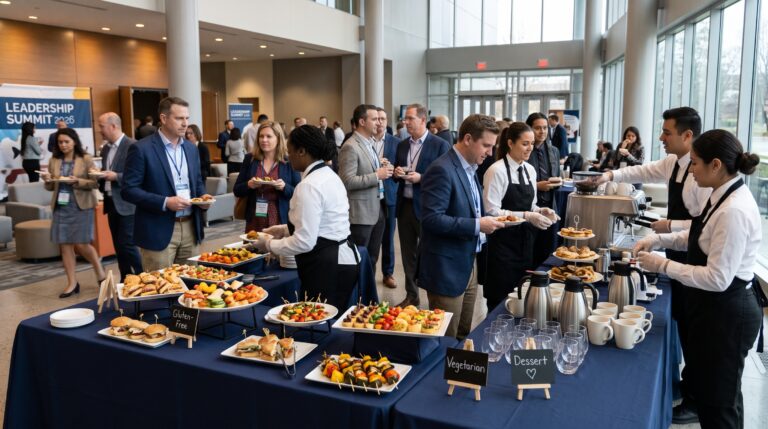
Food used to be treated as a supporting act. That is no longer the case, though. In a review of venue planning trends, for example, Hospitality Net reported that planners rated food and beverage at 9.0 out of 10 in importance in 2025, up from 7.9 two years earlier. Likewise, the pattern matches what I hear in my own client debriefs. Attendees forgive a slow WiFi connection. On the other hand, they do not forgive a cold lunch that ran out before the last table got there.
The money side, moreover, tells the same story. A roundup of event industry figures from Fielddrive notes that roughly 39 percent of event budgets go toward venue and catering, with food and beverage costs climbing at many venues. So when close to two fifths of your budget sits in one category, the way you order, track, and adjust that category stops being a clerical detail. Instead, it becomes a financial control.
Besides, the volume is not slowing. According to Olo’s year end recap, catering orders on its platform grew 47 percent year over year in 2025, with Thanksgiving becoming its largest catering day ever. Clearly, then, group dining, both corporate and personal, is back in a big way.
What Online Catering Ordering Actually Means Today
When I say online catering ordering, I am not talking about a restaurant website with a “call us for large orders” banner. Rather, the tools I see working well in the field share a few traits.
First, they present catering as a structured menu built for groups, with per person pricing, minimums, and portion guidance rather than a list of single entrées. Second, they capture logistics in the same flow as the food, such as delivery window, setup requirements, dock access, utensils, and serving staff. Third, they generate a confirmation that everyone can see and that updates when something changes. Finally, the better ones connect to the rest of the event data, so headcounts and dietary needs do not have to be retyped by hand.
That last part, above all, is where the real transformation happens. Ordering food online is convenient, of course. Yet ordering food online from the same data that drives your registration is a different game entirely.
The industry, meanwhile, has moved quickly here. For instance, a report summarized by Lunchbox found that about 75 percent of catering orders now take place online, and that 80 percent of companies order catering at least monthly. Consequently, for a lot of corporate admins and event coordinators, the phone call is now the exception.
Five Ways Online Catering Ordering Is Reshaping the Planning Process
1. Headcounts Stop Being a Guessing Game
The sales summit story I opened with is not unusual. In my experience, in fact, the single most common catering failure is a headcount that drifts between what registration knows and what the kitchen knows. After all, every manual handoff is a chance for the number to go stale.
With a modern online catering ordering setup, however, the planner can lock in a guaranteed count by a set deadline and then adjust within an agreed range as registrations move. For this reason, I now build a simple rule into most of my client projects. Specifically, the catering count gets reviewed at three fixed checkpoints, typically fourteen days, seven days, and seventy two hours out. Each review happens inside the ordering portal, not over email. Then, when the number changes, the caterer sees it instantly, and there is a timestamped record of who changed it and when.
That record matters more than people think. Whenever a dispute comes up over what was ordered, nobody has to dig through inbox threads. Instead, the order history settles it in thirty seconds.
2. Dietary Needs Move From an Afterthought to a Data Field
Ten years ago, dietary requests showed up as a handwritten note on a registration form, if they showed up at all. Today, by contrast, guests arrive expecting the menu to account for them. A piece from Tripleseat on event menu trends, for example, put it well, noting that guests now expect the event menu to “know” them before they arrive.
The practical shift, then, is this. When your registration form collects dietary information in structured fields (vegetarian, vegan, gluten free, nut allergy, halal, kosher, and so on), that data can flow straight into the catering order. As a result, instead of telling a caterer “we have a few vegetarians,” you send a precise count with names tied to table assignments or badge markers.
On a recent leadership retreat I supported, for instance, this cut our onsite dietary issues to zero. Not reduced, but zero. The kitchen had labeled boxed meals with first names and table numbers, all pulled from the same export. That is the kind of detail attendees remember, and besides, it costs almost nothing once the data path is set up.
3. Menus Are Becoming Modular, and Quoting Is Faster
One trend I have welcomed is the move away from rigid catering packages. In particular, Caterease describes the rise of modular menus, where caterers build offerings from core components with optional enhancements, and notes that this approach speeds up quoting and approvals in corporate settings.
From a planner’s chair, this is huge. Under the old model, I would request three package quotes, wait two days, and then go back and forth to swap a side dish or add a coffee service. With a modular online ordering interface, however, I can assemble the menu myself, see the price update as I go, and send a near final version to my client for approval the same afternoon. Of course, the caterer still reviews it and can push back on anything that does not work for their kitchen. Even so, the starting point is far closer to the finish line.
In addition, there is a budget benefit. When clients can see in plain numbers that adding a hot breakfast station costs a certain amount per head, they make faster, cleaner decisions. In short, transparency removes a lot of the friction that used to slow down sign off.
4. Repeat Events Become Easier to Run and to Improve
Many of the organizations I work with run the same type of event again and again, such as quarterly board meetings, monthly training days, and annual client appreciation dinners. Online catering ordering, therefore, turns each of these into a template.
For example, you can reorder last quarter’s lunch with two clicks and then adjust based on what you learned. Maybe the wraps went untouched while the salad bar ran dry. Because past orders are stored in the system, those notes become part of the plan instead of something somebody half remembers.
The caterers have noticed this too. Indeed, a report from the Monkey catering platform, covered by Food On Demand, found that 60 percent of catering orders come from just 5 percent of customers, which shows how central repeat business is. For planners, consequently, that is useful leverage. If you are a reliable repeat client, you have room to negotiate pricing, priority delivery windows, or dedicated account support.
5. Delivery and Setup Are Finally Part of the Plan
The food itself is only half the job. The other half, meanwhile, is getting it to the right room at the right time, set up correctly. I have seen beautiful menus fail because a delivery driver went to the main hotel entrance instead of the loading dock and then waited twenty minutes for someone to answer a phone.
Now, however, online catering ordering lets planners specify delivery instructions, contact names, dock hours, elevator access, and setup requirements in the order itself. Some platforms also provide live delivery tracking, so the onsite lead can see that the food is ten minutes out and have staff ready.
Furthermore, the Food On Demand coverage of the Monkey report noted that in house delivery made up 53 percent of catering orders in 2026, up from 31 percent in 2021. In other words, more caterers are controlling their own delivery. In my experience, that usually means better handling of fragile items and staff who actually know how to set up a buffet line.
The Planning Timeline, Rewritten
To show how this plays out, here is roughly how I structure corporate event catering on a mid sized program now, compared with how it ran when I started.
At first, the old way looked like this. Request quotes by email. Then wait. Next, compare PDFs side by side and call to negotiate. After that, send a signed contract, email a headcount two weeks out, and email it again a week out. Finally, call the day before to confirm, and hope.
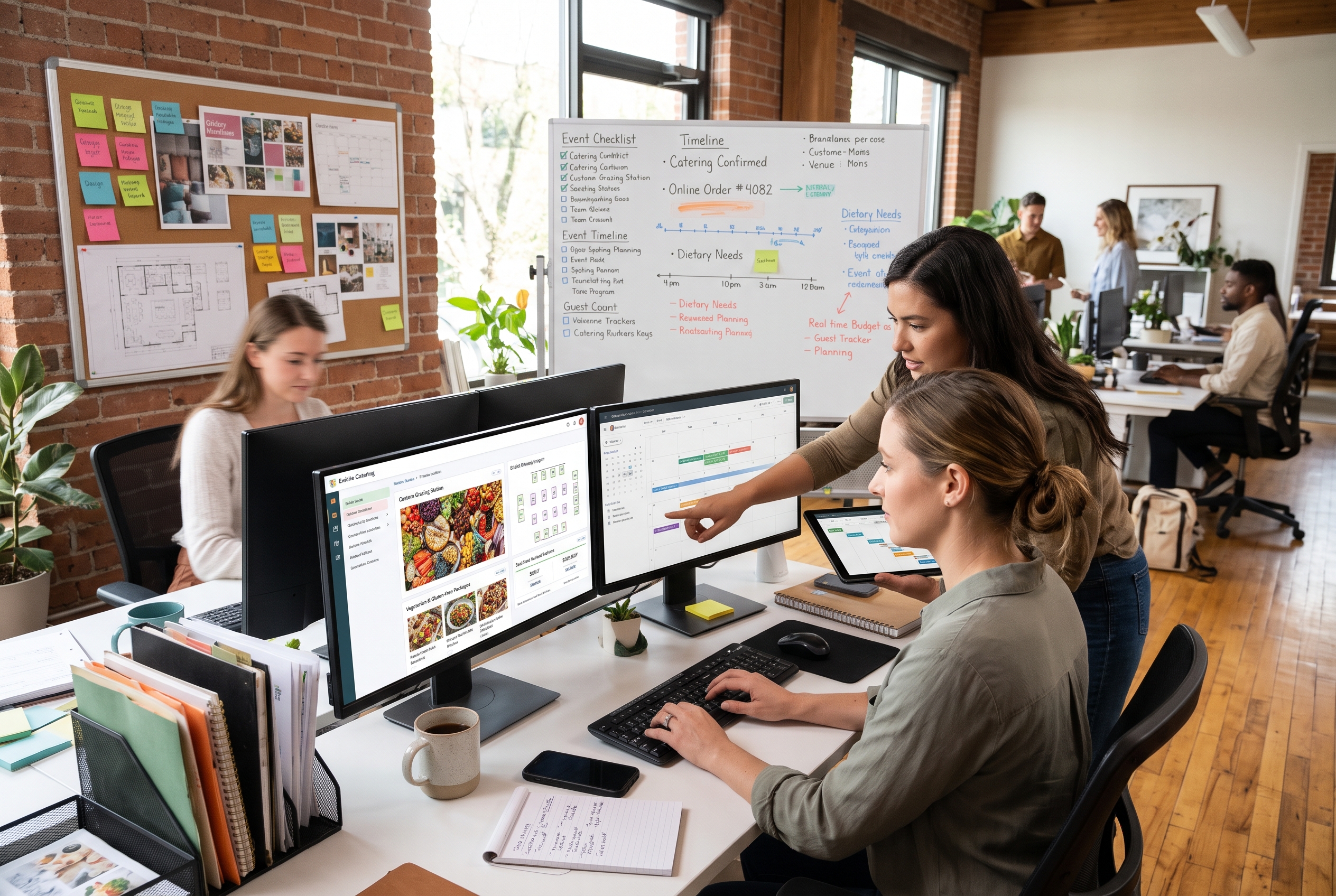
By comparison, the current way looks like this. To begin with, I build the menu in the caterer’s ordering portal at the budget stage, so the client sees realistic numbers early. Next, I connect or import registration data so headcount and dietary counts update on a schedule. Then I review the order at three checkpoints and confirm logistics inside the order. On the day itself, I track delivery. Afterward, I pull the final invoice from the same system and match it to the order history.
The difference, however, is not just speed. Above all, it is visibility. Everyone involved, from the client to the venue coordinator to the catering manager, looks at the same version of the truth.
Where Online Catering Ordering Still Falls Short
That said, I would be doing readers a disservice if I painted this as a solved problem. It is not. Here, then, are the issues I run into most often.
Integration Is Uneven
Plenty of catering platforms still operate as islands. For example, they do not talk to registration software, and they do not export clean data for your budget tracking. Event teams, meanwhile, already juggle a lot of tools. In fact, Blackthorn’s 2026 trends analysis points out that too many event tech tools can actually hurt results, and I agree completely. Therefore, before adopting any ordering platform, ask how it gets data in and out. If the answer is “you can download a PDF,” keep looking.
Marketplace Fees Can Hide in the Price
Third party catering marketplaces have become a major channel. According to the Monkey report coverage on Food On Demand, marketplace share of catering orders is projected to reach 36 percent in 2026, up from 12.8 percent in 2021. These platforms are great for discovery and convenience. Still, commission structures have to be paid by someone. Likewise, analysis from Nexdigm notes that digital marketplaces improve access but can compress caterer margins through commissions. As a result, sometimes that cost shows up in menu pricing, and other times in service fees.
My advice, therefore, is simple. For a one off event in an unfamiliar city, a marketplace can save you hours. For a recurring program, however, compare the marketplace price against ordering directly through the caterer’s own system. In many cases, the gap is meaningful.
Technology Cannot Replace a Conversation
Some things, of course, still need a human. For instance, a plated gala dinner with wine pairings, a cultural celebration with specific food traditions, or an outdoor event with weather contingencies all need a real conversation with the catering lead. Online catering ordering handles the structured parts beautifully. Even so, it does not replace the judgment of an experienced chef or catering manager who has seen what goes wrong when a buffet sits in direct afternoon sun.
For this reason, I tell clients to think of the portal as the system of record, not the whole relationship. In practice, use it for numbers, logistics, and approvals. Meanwhile, pick up the phone for anything creative or risky.
Not Every Team Is Ready
In addition, there is a human adoption curve. Eventective’s research found that while 36 percent of respondents planned to use AI for event planning in 2026, nearly two thirds of planners were not using it at all. Similarly, the same caution applies to catering tools. A system only helps if the people using it trust it. Consequently, training an admin team for thirty minutes on how to update a headcount properly will do more than any feature list.
Where This Is Heading Next
Looking at what I see in client projects and vendor demos, a few directions stand out.
First of all, smarter forecasting is coming. Caterers with years of order history are starting to suggest quantities based on event type, time of day, and attendee mix. For example, a morning workshop with a younger crowd tends to eat differently than an evening donor dinner. So when that history feeds suggestions, waste drops. Notably, Persistence Market Research highlights the combination of digital ordering, AI menu planning, and waste reduction as a defining opportunity, with some operators reporting food waste reductions of 20 to 30 percent.
Second, sustainability reporting is growing. Clients increasingly want to know where their food came from and how much was thrown away. Indeed, BoomPop’s 2026 trends overview reports that 83 percent of corporate organizers now factor sustainability into planning decisions. Therefore, ordering platforms that track sourcing and leftover volumes will make that reporting far easier.
Third, the connection to hybrid and distributed events is getting tighter. When part of an audience joins remotely from regional offices, for instance, some organizations now send local catering to each hub, all managed from one central order. That used to be a nightmare to coordinate. With good online catering ordering, however, it is becoming routine.
Finally, I expect more pressure on measurable outcomes. Expopass describes the 2026 shift as tech being judged on business results and operational efficiency rather than novelty. Catering, of course, is no exception. As a result, planners will want to see cost per attendee, waste per event, and satisfaction scores tied to food, all coming out of the same system.
Practical Advice for Planners Making the Switch
If you are still running catering through email threads and phone calls, here is how I would start.
- Pick one recurring event as a pilot. For example, a monthly meeting or quarterly training day works well. Then run it through an online ordering system three times before you judge the results.
- Standardize your dietary fields. In other words, make sure your registration form collects dietary needs in fixed categories, not free text. Above all, this single change makes everything downstream easier.
- Set headcount checkpoints and stick to them. First, agree with the caterer on dates and allowable adjustments. Then put those dates on the event calendar for everyone involved.
- Ask the integration question early. Specifically, find out how data gets in and out of the platform. After all, clean exports matter more than flashy features.
- Compare marketplace and direct pricing. For recurring programs, in particular, the difference often justifies ordering directly.
- Keep the human channel open. In short, use the portal for structure, and also keep a named contact at the catering company for everything else.
- Review after every event. Look at what was ordered against what was eaten, and then adjust the template. Over a year, as a result, these small corrections add up to real savings and better guest experiences.
Final Thoughts From the Operations Side
The best event days I have worked on are the ones where nobody talks about logistics. Guests notice good food, smooth service, and above all the absence of problems. However, they rarely see the systems that made it possible.
Online catering ordering is one of those quiet systems. Admittedly, it does not make a menu more delicious or a chef more talented. Instead, it removes the gaps where errors used to hide, such as the stale headcount, the lost dietary note, and the driver at the wrong door. For a category that eats up such a large share of most event budgets, therefore, closing those gaps is not a minor upgrade. Ultimately, it changes how confidently you can plan.
Seventy missing lunches taught me that lesson the hard way. So, frankly, I would much rather planners learn it from a well built order screen.
Frequently Asked Questions
What is online catering ordering?
Online catering ordering is the process of selecting, customizing, and confirming group food orders through a digital platform instead of by phone or email. In addition, good systems handle menus, headcounts, dietary needs, delivery details, and payment in one place. For a sense of how widespread this has become, for example, Lunchbox reports that about 75 percent of catering orders now happen online.
How far in advance should I place a catering order for an event?
For small office events, many caterers accept online orders 24 to 48 hours ahead. For events above roughly 100 guests, however, I recommend placing the initial order two to four weeks out and then confirming the final count about 72 hours before. Also, always check each caterer’s minimum notice period, since busy seasons fill up quickly. For instance, Olo noted Thanksgiving 2025 as its largest catering day ever.
Is ordering through a catering marketplace more expensive than ordering direct?
It can be. Marketplaces offer convenience and choice, but commissions are built into the economics. In fact, Nexdigm notes that marketplace commission structures can compress caterer margins, which may affect pricing. Therefore, for recurring events, compare both routes before committing.
How do online ordering systems handle dietary restrictions?
Most platforms let you specify counts for common dietary needs and add labeling instructions. However, the best results come when registration forms collect dietary data in structured fields that feed into the order. Moreover, guest expectations here keep rising, with Tripleseat observing that attendees expect menus tailored to them before they arrive.
Can online catering ordering help reduce food waste?
Yes, because accurate headcounts, order history, and smarter quantity planning all help. For example, Persistence Market Research reports that digital ordering combined with AI menu planning can help operators cut food waste by 20 to 30 percent.
What should I look for when choosing an online catering ordering platform?
Look for clear per person pricing, flexible modular menus, structured dietary options, delivery and setup instructions, change tracking, and clean data exports. In addition, avoid adding a tool that cannot connect to your existing stack, since Blackthorn warns that too many disconnected event tools can hurt performance.
References
- Hospitality Net. 2025 in review: the new realities reshaping event venues
- Fielddrive. 90+ Event Planning Industry Statistics Every Planner Should Know in 2026
- Olo. Restaurant Trends That Defined 2025 and How Olo Powered Them
- Lunchbox. 25 Catering Stats to Know in 2025
- Tripleseat. Flavor Forward: Exploring the Top Event Menu Trends of 2026
- Caterease. 2026 Catering Trends That Aren’t Obvious Yet
- Food On Demand. Monkey Catering Platform 2026 State of Catering Report Coverage
- Blackthorn. 2026 Event Industry Trends Every Planner Must Know
- Nexdigm. USA Catering Industry Insights
- Eventective. 2026 Event Industry Trends and Research
- Persistence Market Research. Catering Services Market Size, Share, and Growth Forecast 2026 to 2033
- BoomPop. Event Management Trends Shaping the Industry in 2026
- Expopass. Top Event Tech Trends for 2026: Proven vs Hype