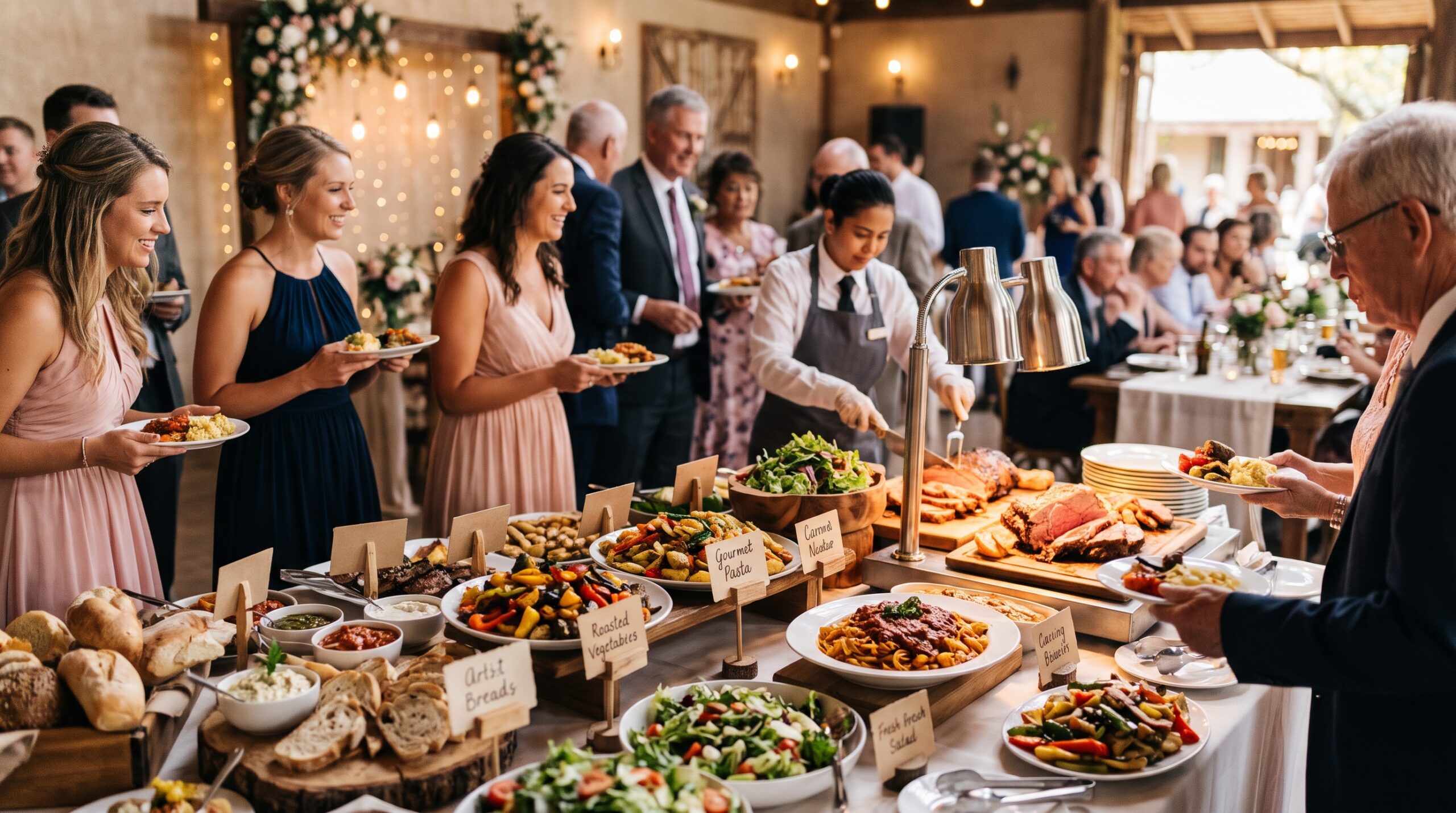
Every tasting I run starts with the same moment. The couple sits down to talk through their wedding buffet menu, someone’s mother has a folder full of printouts, and before I say anything, one of them says, “We don’t want it to feel like a hotel brunch.” Honestly, I get it. However, after years of selling and running wedding catering, I can tell you a buffet doesn’t feel cheap because of the format. Instead, it feels cheap when nobody planned it properly.
In fact, a good wedding buffet menu is one of the warmest ways to feed a room. People pick what they love, go back for the dish they can’t stop talking about, and as a result the meal feels generous rather than rationed. On the other hand, a bad one means long lines, cold chicken, and a salad bar that’s been picked clean by table four. Still, the difference is almost never the budget. Rather, it comes down to decisions made months earlier, usually at a kitchen table with a caterer who asks the right questions. (If you’re still deciding who that caterer will be, start with our guide on how to choose a caterer.)
So this is how I walk couples through it, in roughly the order I’d do it if you were sitting across from me.
Why the Wedding Buffet Menu Got a Bad Reputation
For most people, the idea of a buffet comes from a conference center or a casino. You know the picture: steam trays, sneeze guards, and a ladle sitting in gravy. Of course, that isn’t what a well run wedding buffet looks like. Even so, the memory sticks, and as a result a lot of couples come in apologizing for even thinking about one.
That’s why I tell them that buffets have real advantages plated service can’t match. First, guests get choice, which matters more than ever because so many people now eat around allergies, religious rules, or personal preferences. Second, portions take care of themselves, since the rugby player and the great aunt each take what they want. Finally, the money usually works out better. Staffing costs could be about 20 percent less than they would be for a plated or family style meal, depending on the layout and how much service you want. For a deeper side by side look, see our comparison of buffet vs plated dinner service.
That said, the trade off is that a buffet asks more of the planning. After all, plated service hides mistakes because the kitchen controls everything. A wedding buffet menu, by contrast, puts your choices on a table for everyone to see. So let’s make good ones.
Start Your Wedding Buffet Menu With the Guest List, Not the Food
I know, you came here for menu ideas. Nevertheless, the first thing I ask about is never the food. Instead, it’s the people.
Guest Count and Crowd
Before we talk dishes, I want to know the following:
How many guests, really? In other words, not the invite count, but the realistic RSVP count. After all, that number drives how many lines we set, how much we cook, and how many staff I schedule.
Who’s coming? For example, a guest list that’s heavy with college friends eats differently from one that’s mostly extended family over sixty. Similarly, lots of kids changes things too. Kids eat less, but on the other hand they eat fast and they eat plain.
Timing, Cocktail Hour, and Venue
What time is dinner served? If guests have been at a ceremony since three in the afternoon and dinner opens at seven thirty, then they’re going to arrive at the buffet hungry. Consequently, that changes portion planning a lot.
What happened before dinner? For instance, a long cocktail hour with heavy passed appetizers means a lighter appetite at the buffet. In contrast, a short one with just a cheese board means people walk in starving.
What’s the venue like? Specifically, I need to know where the kitchen is, how far we’re carrying food, whether there’s power for chafing setups, and whether we’re inside or outside in August.
Admittedly, none of this is glamorous. Yet it’s the base your entire wedding buffet menu sits on. In my experience, the couples who skip this step are the ones who run out of food at 8:15.
Build Your Wedding Buffet Menu Around One Anchor Dish
This is, above all, the most useful piece of advice I can give you. Unfortunately, it’s also the one I see couples ignore most often.
First, pick one dish that’s the heart of the meal, meaning the thing people will mention on the drive home. Then build everything else to support it.
For one couple, for example, it was the groom’s grandmother’s braised short ribs, which we adapted from her handwritten recipe card. For another, it was a slow roasted porchetta carved at the end of the line. Likewise, I’ve done a whole wedding buffet menu around a Filipino lechon, and another around a Lowcountry shrimp boil served on long butcher paper tables. In each case, the anchor gives the menu a personality. Without one, however, you end up with a pleasant but forgettable lineup of chicken, pasta, green beans, and rolls that nobody remembers by Monday. If you need a starting point, browse our buffet catering ideas for anchor dishes that hold up well on a line.
Once you have the anchor, next ask what plays well next to it. For instance, rich, heavy mains want bright sides, like a citrus salad or pickled vegetables. Meanwhile, a delicate fish anchor wants a starch with some body, like herbed farro or crispy potatoes. In short, think of it like building a plate, except your guests are doing the plating.
The Five Building Blocks of a Balanced Wedding Buffet Menu
When I write a proposal, almost every wedding buffet menu comes down to five sections. Of course, you can add stations and extras on top, but these are the bones.
1. Salads and Cold Starters
To begin with, the salad section is where guests start, so it sets the tone. For that reason, I like two salads: one leafy and one grain or vegetable based. For example, pair a crisp green salad with a house vinaigrette, plus something heartier like roasted beet and farro or a Mediterranean orzo. The grain salad keeps well on the table for an hour, whereas greens wilt if dressed too early, so we dress them in small batches.
2. Proteins
For most weddings, two proteins are the sweet spot, plus a real vegetarian main that isn’t an afterthought. Additionally, three proteins is lovely for larger guest counts or if you want a carving station. Beyond that, however, the line slows down because people stop and deliberate.
3. Starches
Potatoes, rice, pasta, polenta, and grains all work, so pick one that suits your anchor. Starches are also where you can save money without anyone noticing, because a great roasted potato is genuinely loved and costs very little.
4. Vegetables
Similarly, plan one or two seasonal vegetable dishes. This is where I push couples to trust the season. For example, charred broccolini in spring, blistered green beans in summer, or maple roasted squash in fall. After all, vegetables in season taste better and cost less.
5. Bread
Surprisingly, people underestimate bread. Good rolls or a sliced focaccia with whipped butter make the whole spread feel generous. On the other hand, bad, dry dinner rolls make it feel like a banquet hall.
Finally, dessert usually lives on its own table, often with the cake, so it sits outside the main wedding buffet menu.
How Much Food Does a Wedding Buffet Menu Need?
This is the question I get asked the most. Not surprisingly, it’s also the one where well meaning relatives give the worst advice.
Baseline Portions for a Wedding Buffet Menu
In general, buffets need more food per person than plated meals. That’s because when someone’s serving themselves, they take a bit of everything, and they also take a bit more of what looks best. As a working baseline, culinary training materials suggest planning proteins at 6 to 8 oz per person (with 2 options, estimate 3 to 4 oz each), starches and vegetables at ½ cup per person, and bread or rolls at 1 to 1.5 pieces per person. For salad, similarly, accounting for eight ounces (or roughly one cup) of salad per guest is a good rule of thumb.
How I Adjust the Numbers
Keep in mind that those are only starting points. In practice, I adjust them like this:
Bump the protein up if dinner is late, if your crowd skews young and hungry, or if the cocktail hour was light.
Bump the most popular protein up further. For example, if you’re serving a beef dish and a chicken dish, people will take more beef, every time. Therefore, I plan the split at roughly sixty to forty in favor of the premium option.
Pull the starch down slightly if you’re serving pasta and potatoes together. After all, nobody needs a full portion of both.
Plan for seconds on your anchor dish. Since it’s the thing people go back for, running out of it is the one mistake guests actually notice.
Above all, a good caterer won’t just give you a per person count. Instead, they’ll explain how they arrived at it. So if someone can’t tell you how much protein per head they’re cooking, ask more questions. Our full guide to how much food per person for a buffet walks through the math in more detail.
What a Wedding Buffet Menu Really Costs
Couples are often surprised by buffet pricing because they assume it’s automatically the budget option. It can be. However, it’s not always the cheapest choice by a wide margin.
National Price Ranges
To be fair, national numbers vary depending on who’s surveying. For instance, Zola reports that buffet style service runs $40 to $65 per person, compared with $65 to $85 for formal plated dinners and $50 to $70 for family style meals. WeddingWire’s figures, by comparison, come in lower, putting the average at $40 per person for a plated meal and $27 per person for a buffet. In any case, your local market, your menu, and what’s included in the price will move these numbers a lot. Our breakdown of catering cost per person explains which line items move the number most.
What Drives a Wedding Buffet Menu Quote
From where I sit, here’s what drives a wedding buffet menu quote up or down:
Protein choice. Beef tenderloin and seafood cost far more than chicken thighs or pork shoulder. Moreover, a carving station adds a chef’s labor on top.
Staffing. An attended buffet, where servers portion the proteins, costs more than full self serve. Even so, it controls portions and keeps the line moving, so I usually recommend it for proteins at least.
Rentals. Chafing dishes, risers, linens, and serving pieces all add up. Consequently, if your venue doesn’t supply them, they show up on the bill.
Minimums. Many caterers require minimum orders of $2,500 to $4,000 no matter how few guests you have, which is why smaller weddings often pay more per head. The same minimums often apply to corporate event catering, so ask about them early for any event.
So my honest advice is this: decide where you want to spend, and then be ruthless everywhere else. For example, put money into the anchor dish and the bread. Meanwhile, save it on the third salad and the fancy garnish nobody eats.
Wedding Buffet Menu Layout and Flow
You can have the best food in the state and still have a bad buffet if the line takes forty five minutes. In fact, flow is the part couples rarely think about and, at the same time, the part I obsess over.
How Many Lines You Need
As a long standing food service rule, plan one complete buffet line for every 100 guests, while a two sided table can serve 200 people. For a wedding of 150, therefore, I almost always set a double sided buffet. Over 200, I’ll either set two double sided tables or split into stations.
Table length matters too. For example, one rule of thumb from event pros is 1 linear foot of buffet per three or four guests, with between 18 inches and 2 feet between the lines on either side of the table. If the venue can’t fit that, then we rethink the layout early instead of finding out on the day.
The Order of Your Wedding Buffet Menu on the Table
Notably, the order of dishes isn’t random. Here’s how I lay it out:
- First, plates at the very start, never in the middle.
- Next, salads and cold items.
- Then starches and vegetables.
- After that, proteins near the end.
- Finally, bread, butter, and sauces last.
Why put the proteins last? Simply because if you put the expensive stuff first, people fill half their plate before they see the rest. By contrast, putting salads and sides first naturally manages portions. Likewise, keep condiments at the end, since the last thing you want is for people to double back because they forgot to get dressing for their salad.
Staffing the Line
Even a self serve buffet needs people. As a general guide, Bridal Guide notes that the average double sided buffet line can provide enough for about 100 guests, with one server per every 25 guests. Those staff, in turn, are refilling trays, helping guests with questions about ingredients, and keeping things tidy so the last table up sees the same spread as the first.
Releasing Tables
Please don’t just announce “dinner is served,” because that’s how you get a stampede. Instead, have your coordinator or DJ release tables a few at a time. Start with the couple and wedding party, then grandparents and older guests, and then everyone else. Also, rotate who goes last so it isn’t always the same friends’ table.
Here’s a trick I love, too: serve the salad course plated, or put bread and a small starter on each table. That way, people are eating something, so they don’t mind waiting. In contrast, people staring at an empty plate do.
Food Safety for Your Wedding Buffet Menu
Admittedly, this is the part of my job couples never see, and I’d like to keep it that way. Still, you should know what a responsible caterer is doing behind the scenes, especially if a relative suggests a DIY buffet.
Time and Temperature Rules
Fortunately, the key rules come straight from federal food safety guidance. The FDA says to discard any perishables left out at room temperature for more than 2 hours, unless you’re keeping it hot or cold. Outdoor summer weddings, in particular, are where this matters most, since if the buffet is held in a place where the temperature is above 90 °F, the safe holding time is reduced to 1 hour.
As for holding temperatures, USDA guidance is that hot foods should be held at 140 °F or warmer. Cold food, similarly, needs to stay cold, so the advice is to place cold food in containers on ice to keep food below 40ºF. The range in between, meanwhile, is where bacteria grow quickly. The Minnesota Department of Health and UC Agriculture and Natural Resources both offer practical guides for keeping large group buffets in that safe zone.
Swap Trays, Don’t Top Them Up
In addition, there’s one more rule I’m strict about with my staff: we swap trays, we don’t top them up. USDA advises that you replace empty platters rather than adding fresh food to a dish that already had food in it, because hands have been at that dish and it’s been sitting out.
Ultimately, if your caterer can’t tell you how they’re holding temperatures and how often they’re checking, that’s a red flag.
Planning a Wedding Buffet Menu Around Allergies and Dietary Needs
Ten years ago, I’d get one or two dietary notes per wedding. Now, by contrast, I get a spreadsheet. That’s fine, though, because a buffet is actually the best format for this, as long as it’s planned well.
In the United States, nine foods account for 90% of food allergies: milk, eggs, peanuts, tree nuts, wheat, soy, fish, crustacean shellfish, and sesame. Sesame, notably, is the newest addition, and it hides in a lot of dressings, breads, and marinades.
For that reason, here’s what I do with every wedding buffet menu:
Label every dish. Use a small card with the dish name and the major allergens it contains. As a bonus, this cuts down on guests asking servers the same question two hundred times.
Keep at least one main that’s free of the big allergens. For example, a roasted chicken with herbs and olive oil, or a well seasoned vegetable main, can cover a lot of guests at once.
Use separate serving utensils for every dish, and make sure they stay with their dish. After all, cross contact on a buffet usually happens through a shared spoon.
Plate severe allergy meals separately. For guests with serious allergies, I don’t make them use the buffet at all. Instead, we plate their meal in the kitchen and bring it to their seat. That way, it’s safer and, equally important, it’s kinder.
Finally, make sure your RSVP card or website asks about dietary needs, so you can pass a full list to your caterer at least a month before the date. Many of the best event planning apps let guests note allergies right on their RSVP.
Making Your Wedding Buffet Menu Feel Personal
This is where a wedding buffet menu goes from good to memorable. Simply put, guests remember food with a story.
With that in mind, here are a few ideas I’ve seen work beautifully:
Family recipes. For instance, a grandmother’s potato salad, a dad’s barbecue rub, or the cookies that show up at every holiday. Most good caterers will work from a family recipe, provided you give them time to test it.
Where you met or where you’re from. For example, a couple who met in Chicago had a small Italian beef station. Similarly, another couple, from two different cultures, served a dish from each family side by side with little cards explaining what each meant to them.
Small signage with a note. “Mike’s favorite since he was six” next to the mac and cheese, for instance, gets a laugh and a photo every time.
A late night snack. Although it’s not technically the buffet, sliders, tacos, or a pizza drop at ten thirty is the thing guests rave about the next day. A simple delivery set up through online catering ordering is often all it takes.
That said, keep the personal touches to two or three. Otherwise, if every dish has a story, none of them stand out.
Wedding Buffet Menu Tasting Tips
Your tasting isn’t just about whether the food is good. Rather, it’s an interview. So here’s what to pay attention to:
Ask how the food holds. A dish can taste perfect straight from the pan and yet fall apart after forty minutes in a chafer. Therefore, ask the caterer directly which dishes they’d recommend for buffet service and which they wouldn’t.
Taste the vegetarian main as seriously as the meat. After all, if it’s sad at the tasting, it’ll be sadder on the day.
Ask to see a photo of a real buffet setup they’ve done, rather than a styled shoot.
Bring one honest person. In other words, not the whole family, but one person whose palate you trust and who’ll tell you if the sauce is too sweet.
Ask what happens if food runs low. A good caterer has a plan. A great one, however, doesn’t need it, because they cooked enough.
Common Wedding Buffet Menu Mistakes I See Over and Over
After more weddings than I can count, the same few problems keep showing up. Fortunately, if you avoid these, you’re ahead of most couples.
Too many choices. Couples think more options means more generous. In reality, though, it means a slower line and more waste. Generally, two proteins, two salads, two sides, and bread is plenty for most weddings.
Trendy over tasty. A dish that looks great on social media but doesn’t hold well on a buffet will disappoint. Instead, stick with food that tastes as good at minute forty as it did at minute one.
Ignoring the season and the weather. For example, heavy braises at an outdoor July wedding, or a ceviche bar in a hot tent. So think about how the food fits the day.
Forgetting the vendors. Your photographer, DJ, and coordinator need to eat as well, and ideally they eat early so they’re ready when the speeches start. Accordingly, include them in your headcount.
No plan for leftovers. Ask ahead of time what your caterer’s policy is, because food safety rules often limit what can go home. Besides, it’s better to know than to be disappointed at midnight.
A Simple Wedding Buffet Menu Planning Timeline
To keep things simple, here’s the rough timeline I give couples:
9 to 12 months out: First, book your caterer, confirm your guest count range, and decide on buffet service.
6 months out: Next, choose your anchor dish and rough menu direction, and then schedule your tasting.
3 to 4 months out: After that, do the tasting, finalize the wedding buffet menu, and sort out rentals.
6 to 8 weeks out: Then collect dietary needs from RSVPs and pass them to your caterer.
2 to 3 weeks out: At this point, give your final headcount, confirm the layout, and agree on table release order.
The day of: Finally, eat. Seriously. Ask your caterer to set two plates aside for you, because most couples are too busy to make it through the line.
Final Thoughts From Behind the Buffet Table
Interestingly, the best compliment I ever got at a wedding wasn’t about the food at all. A guest came up to the line and said, “This feels like their house.” That, in the end, is what a great buffet does. It feels like being welcomed in, rather than processed through.
Better still, you don’t need a huge budget to get there. Instead, you need a clear anchor dish, the right amount of food, a layout that keeps people moving, and a caterer who takes safety and dietary needs as seriously as flavor. Get those right, and as a result your wedding buffet menu will be the thing people talk about long after the last dance.
Wedding Buffet Menu FAQs
How many dishes should a wedding buffet menu have?
For most weddings, two salads, two proteins plus a vegetarian main, one or two starches, one or two vegetables, and bread is plenty. Otherwise, more choices slow the line. For more inspiration, see The Knot’s wedding buffet ideas.
Is a buffet cheaper than a plated dinner?
Usually, but not always by much. Savings mostly come from lower staffing, whereas premium proteins and rentals can close the gap. For current ranges, see Zola’s breakdown of wedding catering costs.
How much food per person should a wedding buffet have?
A common baseline is 6 to 8 ounces of protein, about half a cup each of starch and vegetables, and one to one and a half rolls per guest. However, adjust for your crowd and timing. WeddingWire’s guide to how much food to serve also covers this in more detail.
How long can food safely sit out on a buffet?
No more than two hours at room temperature, or one hour if it’s above 90°F, unless it’s held hot or cold. For the full rules, read the FDA’s guide to serving safe buffets.
How do I keep the buffet line from getting too long?
First, plan one full line per 100 guests and use double sided tables. Then release tables in small groups, and serve a first course or bread at the tables. In addition, these buffet service tips from FoodService Director are useful for layout planning.
How should a buffet handle food allergies?
Label every dish with its major allergens, give every dish its own utensils, and plate meals separately for guests with severe allergies. Also, the FDA’s page on sesame as the ninth major allergen lists all nine major allergens.
References
- Food and Drug Administration. Serving Up Safe Buffets
- Food and Drug Administration. The FASTER Act: Sesame Is the Ninth Major Food Allergen
- Minnesota Department of Health. Food Safety for Buffets
- UC Agriculture and Natural Resources. Food Safety for Parties and Large Groups
- Nicolet College. Catering Portion Planning Guide
- WeddingWire. Exactly How Much Food to Serve at Your Wedding
- WeddingWire. Wedding Catering Cost Guide
- Zola. Wedding Catering Costs: Real Numbers and Budget Tips
- The Knot. Wedding Buffet Menu Ideas
- Brides UK. Buffet Wedding Reception Guide
- Bridal Guide. Wedding Catering Staffing Ratios
- FoodService Director. 45 Tips for Better Buffet Service
- AOL. How to Properly Set Up a Buffet for Smooth Serving
Leave a Reply