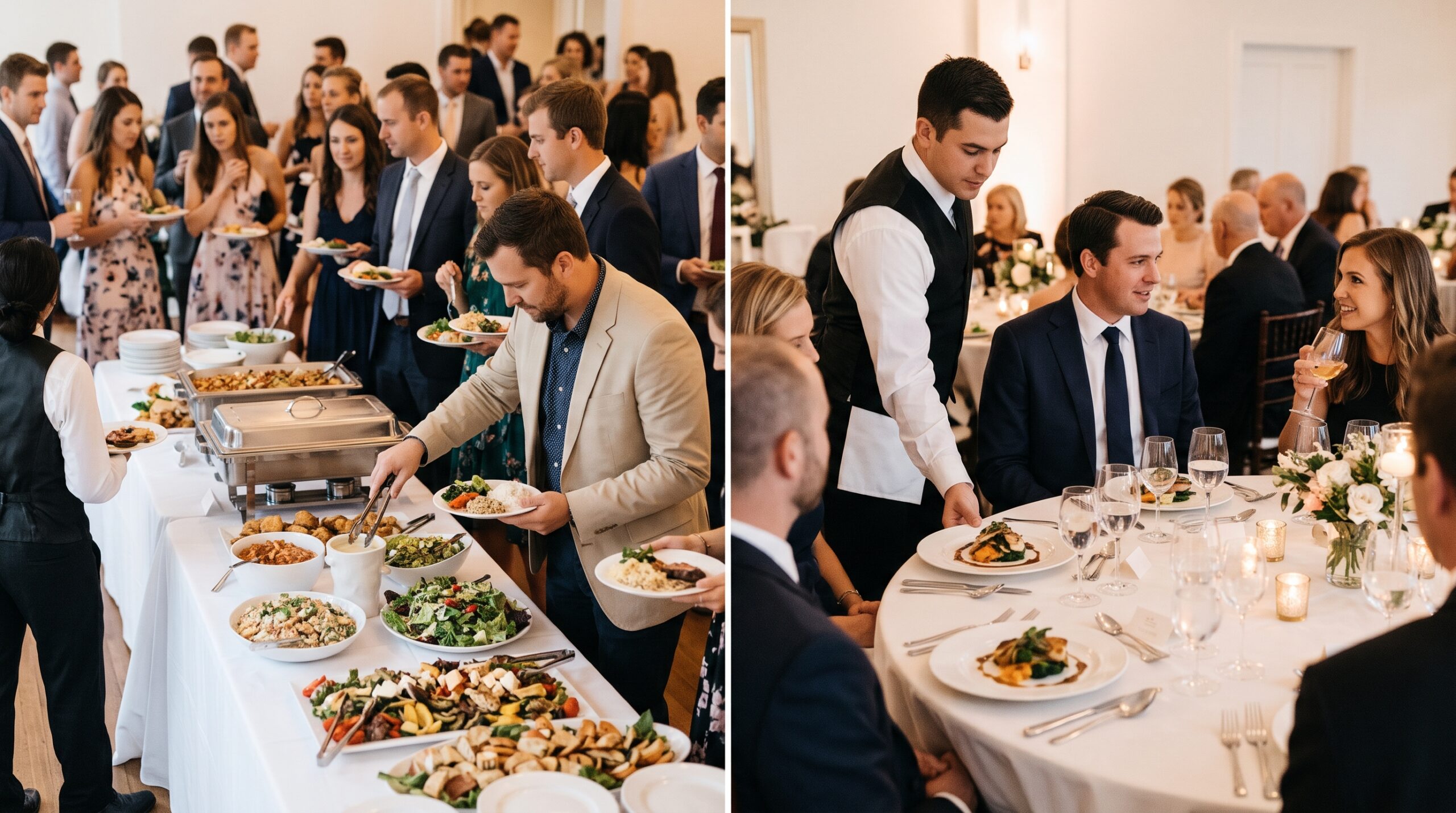
I have spent most of my career on banquet floors, and the buffet vs plated dinner question is the one I hear most at a first tasting appointment. Indeed, it almost never starts with the menu. Before anyone asks whether the short rib comes with polenta or mash, someone at the table leans in and says, “So, should we do a buffet or plated?”
It sounds simple, and it isn’t. Buffet vs plated dinner is really a question about how you want your guests to feel, how your room is shaped, how much labor your budget can carry, and how tightly your evening needs to run. I have watched a beautiful plated dinner turn stiff and slow because the room was wrong for it. Then again, I have seen a buffet with a smart layout feel generous and warm at a black tie fundraiser, which surprised everyone but my banquet captain.
Below, then, is how I actually walk clients through this decision. This isn’t a generic pros and cons list, though. Think of it as the conversation we would have across my desk, with the numbers, the logistics and a few stories from events that taught me something.
Buffet vs Plated Dinner: The Short Answer From Someone Who Has Run Both
If you want my buffet vs plated dinner answer in one breath: choose plated when the evening has a program, a schedule and a formal tone, and choose a buffet when the evening is about mingling, variety and a relaxed pace. Everything else is detail. Those details matter, though, because they’re where events go right or wrong.
The mistake I see most often is choosing a service style based on a picture. For example, someone sees a gorgeous plated course on social media, or remembers a sprawling buffet at a cousin’s wedding, and decides on the spot. Service style should come out of your guest count, your venue, your timeline and your budget, in roughly that order.
What a Plated Dinner Really Involves
With plated service, every guest stays seated and the kitchen sends out individually composed plates, course by course. Usually that means a first course, an entrée and a dessert, with bread and coffee service around them. Guests generally pick their entrée ahead of time on the RSVP card, or the host picks a single entrée for everyone, often with a vegetarian alternative held in reserve.
Behind the swinging doors, however, a plated dinner is a small military operation. My chef runs a plating line where every plate gets the same protein, the same sauce placement and the same garnish, and the plates have to leave the kitchen in waves so a whole section of the room is served at once. Meanwhile, my captains time the pickup so the head table and the far corner get their entrées within a few minutes of each other. When it’s done well, nobody notices any of this. Done poorly, it means half the room eating while the other half watches.
Where Plated Service Earns Its Money
Control of the timeline. If there are speeches, a first dance, an awards presentation or a keynote, plated service lets me build those moments around the courses. I can tell a planner that salads will be cleared by 7:40 and entrées will land by 7:55, and I can hold to it. At a corporate awards dinner I ran for a few hundred guests, the CEO wanted to speak between the entrée and dessert. With plated service, we cleared the room, dimmed the lights and gave him a quiet audience in under six minutes. A buffet would have had guests wandering back for seconds during his remarks.
Consistency for every guest. As a result, everyone gets the same quality, the same temperature and the same presentation. The first guest served and the last guest served eat essentially the same meal.
Formality and comfort. Guests stay in their seats, which matters a great deal, especially for older guests, guests with mobility concerns and anyone in formal wear who would rather not balance a plate across a crowded room.
Predictable food quantities. Because I know exactly how many of each entrée I’m serving, I can order precisely and waste less on the protein side.
Where Plated Service Gets Difficult
Labor cost. Above all, plated service needs a lot of hands. Industry guidance typically puts staffing at roughly 1 server per 15 to 20 guests, and that’s before you count the kitchen team needed to plate everything consistently. That labor shows up on your invoice.
Limited choice. Most plated menus, in fact, offer two or three entrées. Your guests can’t change their minds at the table, and the guest who forgot what he checked on his RSVP card will always exist. I build escort cards with a small discreet symbol for each entrée selection for that exact reason.
More planning on your side. Specifically, entrée counts, place cards, seating charts and meal indicators all need to be finalized and accurate. Plated service only works when the paperwork is right, and many of the best event planning apps can collect entrée choices with each RSVP.
What a Buffet Really Involves
A buffet means the food is displayed on one or more lines, usually in chafing dishes and on platters, and guests move through and serve themselves. Many full service caterers, mine included, also offer what we call an attended buffet, where uniformed staff stand behind the line and portion the food onto guests’ plates. Attended buffets also look more polished, keep portions sensible and move the line faster than pure self service.
Where a Buffet Earns Its Keep
Variety. A buffet can comfortably offer two proteins, a vegetarian main, two or three sides, salads and breads. Guests eat what they actually want, which matters for picky eaters, children and anyone with a long list of preferences. If you need inspiration, our buffet catering ideas show how varied a line can be.
A relaxed, social feel. Movement around the room also breaks up the table groupings. People meet at the carving board, for instance. At a lot of family reunions and casual celebrations, the buffet line is where half the catching up happens.
Generosity. A well stocked buffet communicates abundance, too. Guests can go back for seconds, and nobody walks out hungry.
Possible labor savings. You need fewer servers than with plated service, though you still need staff to replenish, monitor temperatures and keep the line tidy.
Where a Buffet Struggles
Lines. This is the big one. With large guest counts, for example, a single line turns into a queue, and a queue at dinnertime does nothing for the mood. Therefore, plan on about one double sided line for every 100 to 120 guests if you want people eating within a reasonable window.
Uneven experience. The first table released gets the freshest pans and the full selection. By contrast, the last table often finds the popular item running low and the lettuce looking tired. My team fights this by swapping out full fresh pans rather than topping off old ones, but it takes discipline.
Quantity guesswork. Because guests portion themselves, I have to produce more food than an exact headcount suggests, which can cancel out a good part of the labor savings. Our guide to how much food per person for a buffet walks through those numbers in detail.
Timeline drift. It takes time to release tables, let people serve themselves and settle back in. If your program depends on precise timing, a buffet makes that harder to guarantee.
Buffet vs Plated Dinner: The Real Cost Picture
In any buffet vs plated dinner comparison, clients usually assume the buffet is automatically cheaper. Sometimes it is, sometimes it isn’t, and the reason is worth understanding before you sign anything. (For the full breakdown of what drives pricing, see our guide to catering cost per person.)
What a Buffet vs Plated Dinner Costs Per Person
To begin with, recent wedding industry figures show the gap clearly. According to Zola, formal plated dinners cost $65 to $85 per person, buffet service runs $40 to $65 per person, and family style lands in between at $50 to $70 per person. Thumbtack’s editors put it more bluntly, noting that a true plated meal can cost about twice the price of a staff assisted buffet because of staffing costs. For context on the bigger picture, The Knot’s 2026 Real Weddings Study found catering averaged $80 a guest at 2025 weddings, as Money Crashers reports.
Why a Buffet Is Not Always the Budget Option
Still, here’s the part those averages leave out. The Knot has pointed out that while a buffet would seem cheaper across the board, that isn’t necessarily the case, and I agree completely. A buffet saves on servers, but it costs more in food volume, chafing equipment, serving pieces and sometimes linen and table rentals for the lines themselves. If your buffet menu leans on premium proteins like beef tenderloin, lamb or seafood, the extra food you need to produce can close the gap with plated service fast.
How I Break Down a Catering Quote
When I build a quote, I break the costs into these buckets so clients can compare honestly:
- Food cost, driven by menu choice and quantity. Usually higher per guest on a buffet.
- Labor, which includes servers, captains, kitchen staff and bartenders. Typically higher for plated.
- Equipment and rentals, such as chafers, risers, serving utensils, extra china for return trips and buffet tables. Often higher for buffets.
- Service charge and gratuity, typically calculated on the subtotal, so they rise with everything above.
- Venue factors, such as kitchen access, load in time and whether the venue requires its own staff.
Ask two or three caterers to quote both styles with the same menu when you request proposals. Otherwise, you won’t get a real apples to apples comparison.
Buffet vs Plated Dinner by Headcount, Room and Timeline
Guest Count
For small gatherings under about 50 guests, the price difference narrows and both styles work well. A plated dinner for 40 feels like an elegant private dinner party. Serve that same group from a buffet, and it feels like a warm family meal. For the most casual small events, drop off trays arranged through online catering ordering can be simpler still.
Between roughly 75 and 200 guests, on the other hand, you have real options, and the choice comes down to tone and budget.
Above 250 guests, I start steering clients carefully. Plated service at that size needs a large, experienced kitchen and a deep bench of servers, but it gives you control. A buffet at that size needs multiple lines and very disciplined table releases. Otherwise you get the scene I still remember from early in my career: a 300 guest buffet with two lines for the whole room, a toast scheduled for 8:00, and guests still holding empty plates in line when the best man stood up. We changed our standard layout the very next week.
Room Shape
Walk the room with your caterer before you settle the buffet vs plated dinner question. Buffets need floor space for the lines and, in addition, circulation around them. In a narrow ballroom or a tent packed to capacity, the buffet may then end up eating the dance floor. Plated service needs clear service aisles between tables and a short, direct path from the kitchen. A venue with a kitchen two floors away and a single elevator makes plated service slower and riskier.
Timeline
First of all, map your evening hour by hour. If speeches, presentations, a band set and a hard venue curfew are all competing for time, plated service gives you more certainty. When the evening is loose and social, with no fixed program, a buffet’s slower rhythm becomes a feature rather than a problem.
Allergies and Diets in a Buffet vs Plated Dinner
This is where the buffet vs plated dinner decision quietly shapes the guest experience more than people expect.
On a plated dinner, I know every dietary need in advance, by name and by seat number. A guest with a severe nut allergy gets a plate prepared on a clean station, carried by a server who knows exactly who it’s for. That level of control is very hard to match on a buffet.
On a buffet, variety helps vegetarian, vegan and gluten conscious guests find something comfortable, but cross contact is a real risk. For one thing, serving spoons migrate between pans. Guests also drip sauce from one dish into another. For any event with known severe allergies, I either set up a separate allergen aware station or plate those meals individually from the kitchen, even when everyone else is on the buffet.
Whichever style you choose, labeling matters. Every buffet dish my team sets out carries a small card naming the dish and flagging common allergens, and our plated menus are reviewed against the guest list before the final count goes to the kitchen.
Food Safety in a Buffet vs Plated Dinner
This is the part of the buffet vs plated dinner conversation clients rarely bring up, and the one I care about most.
What the FDA Guidance Requires
The FDA’s guidance for buffets is clear. In particular, hot foods should be kept at an internal temperature of 140 °F or warmer. The agency also advises that you discard any perishables left out at room temperature for more than 2 hours, unless you’re keeping it hot or cold. And if the buffet is held in a place where the temperature is above 90 °F, the safe holding time is reduced to 1 hour. That last point matters a great deal for summer tent events and outdoor receptions.
How My Team Manages the Buffet Line
The FDA also warns that some warmers only hold food at 110 °F to 120 °F, which is one reason a professional caterer’s equipment matters. My team carries probe thermometers, logs holding temperatures on every line, and pulls and replaces pans on a schedule. We also follow the long standing practice to replace empty platters rather than adding fresh food to a dish that already had food in it.
Why Plated Service Protects Quality
Plated service sidesteps most of these issues. Food goes from the kitchen to the guest within minutes, and there’s no communal serving area for many hands to touch. Quality, likewise, follows the same logic. For instance, a delicate piece of fish or a perfectly rested steak holds up beautifully on a plate that travels thirty feet. It doesn’t hold up for forty minutes in a chafing dish. When clients want a menu built around something fragile, I gently push them toward plated service, or toward a carving or action station where a chef cooks or slices to order.
Reading the Event: Buffet vs Plated Dinner by Occasion
Over the years I have developed a few instincts about buffet vs plated dinner service for different kinds of events. These aren’t rules, but they’re a solid starting point.
Weddings and Galas
Formal weddings and black tie galas. Plated service usually fits best. The formality, the program and the guests’ attire all point that way.
Relaxed or rustic weddings. Buffets and family style shine here. A barn or garden setting with long farm tables pairs naturally with generous shared food, and a well built wedding buffet menu can carry the whole evening.
Business and Company Events
Corporate dinners with presentations. Plated, almost every time. Executives want the room quiet and attentive when the speaker takes the stage, and plated service gives you that. Our guide to corporate event catering covers more on planning around a program.
Company holiday parties and team celebrations. Buffets or stations work well. After all, the point of the evening is people moving around and talking with colleagues outside their usual circle.
Charity Events and Private Celebrations
Fundraisers and auctions. This depends on the program. If there’s a seated live auction, plated keeps bidders in their seats and paying attention. With a silent auction and an open floor, stations keep people circulating past the auction tables.
Rehearsal dinners and milestone birthdays. For smaller groups, either works equally well. I often suggest family style here because it feels personal without being stiff.
Hybrid Options Between a Buffet vs Plated Dinner
The buffet vs plated dinner question assumes there are only two choices. There are actually several in between, and some of my favorite events have used them.
Plated First Course, Then Buffet
Guests sit down to a served salad or soup, which gets everyone settled and gives you a calm moment for welcome remarks. The entrée is then served from a buffet. You get some of the elegance and timing of plated service with the variety of a buffet.
Duet Plate
Instead of asking guests to preselect an entrée, the kitchen plates a smaller portion of two proteins together, such as a petite filet with a seared salmon or chicken. This removes the RSVP card headache and still feels formal. It does raise food cost, so budget for it.
Attended Stations
A pasta station, a carving station or a raw bar staffed by chefs. Stations combine the interactive feel of a buffet with fresher food. Keep in mind they need staff at each station, so they’re not always cheaper than plated.
Family Style
Platters go to each table, and guests then pass them around. It’s warm and communal and keeps people seated, but it needs larger tables to hold the platters and is labor intensive to replenish.
Plated Dinner, Buffet Dessert
A served dinner followed by a dessert display or late night station. It’s a wonderful way to get guests out of their seats and onto the dance floor after the formal part of the night.
Questions I Ask Before Choosing a Buffet vs Plated Dinner
When a client is torn on buffet vs plated dinner, I go through the same set of questions. If you answer these honestly, the right choice usually becomes obvious.
Guests and Diets
- How many guests are you expecting, realistically? Not the dream number, the number you will actually confirm.
- Does variety matter much to your crowd? Think about children, picky eaters and varied diets.
- Any severe allergies or medical diets on the list?
Venue and Schedule
- What is the program? List every speech, toast, presentation and performance.
- Describe the room for me. Where is the kitchen, how wide are the aisles, and where would buffet lines go?
- Is the event indoors, outdoors or under a tent, and what will the weather be?
- How important is precise timing? Think about hard stops, band contracts and venue curfews.
Goals and Budget
- What tone do you want guests to feel when they walk in? Elegant and hosted, or relaxed and social?
- How large is your total catering budget, including service charges and gratuity?
- What do you want guests talking about the next morning? The food itself, or the atmosphere?
That last question, in particular, matters more than people expect. Couples who want guests raving about the food often lean plated, because the kitchen controls every detail of the plate. Those hoping everyone will call it the best party they have been to in years often lean toward buffets or stations.
My Final Word on Buffet vs Plated Dinner
After all these years, my honest view on buffet vs plated dinner is that neither style is better. Instead, the better style is the one that fits your event. A plated dinner gives you control, polish and a calm room. Buffets, on the other hand, bring variety, warmth and movement. Meanwhile, hybrid formats let you borrow from both.
What makes or breaks either one is execution. For example, a plated dinner with too few servers is slow and frustrating. Run a buffet with too few lines and no discipline on replenishment, and it looks picked over by the last table. So whatever you choose, ask your caterer the hard questions: how many staff they will bring, how many lines they’ll set, how they handle allergies and how they hold food temperatures. A caterer who answers those questions confidently and specifically is one you can trust with your evening. Our guide on how to choose a caterer lists the rest of the questions worth asking.
Buffet vs Plated Dinner FAQs
In a buffet vs plated dinner, is the buffet always cheaper?
No. Buffets usually save on labor, but they require more food and more serving equipment. Industry averages compiled by Zola show buffets typically cost less per person, while The Knot notes that a buffet isn’t necessarily cheaper once menu and quantity are considered. Overall, request quotes for both styles using the same menu.
How many servers do I need for a plated dinner?
A common benchmark is about one server for every 15 to 20 guests, plus captains and kitchen staff. Giggster’s catering cost guide also outlines typical staffing included in plated packages.
How long can food safely sit on a buffet?
According to the FDA’s guidance on serving safe buffets, perishable food shouldn’t sit at room temperature for more than two hours unless it’s kept hot or cold, and that window drops to one hour above 90°F.
Buffet vs plated dinner: which works better for food allergies?
Plated service gives the most control, because each meal is prepared and delivered to a specific guest. If you choose a buffet, however, ask your caterer about labeled dishes and separately plated allergen safe meals.
What is the difference between a buffet and food stations?
A buffet is usually one long line of dishes where guests serve themselves. Stations, by contrast, are separate themed areas, often staffed by chefs, that spread guests around the room. Zola’s buffet vs plated guide covers how these service styles compare for weddings.
What does catering cost per person for a small event?
It varies widely by service style. Eventbrite shows how per person pricing changes with guest count, and Thumbtack explains how staffing drives the gap between buffet and plated pricing.
Can I combine plated and buffet service?
Yes. Popular hybrids include, for example, a plated first course followed by a buffet entrée, a duet plate, attended stations, family style platters, or a plated dinner followed by a dessert display.
References
- Zola. Wedding Catering Costs: Real Numbers and Budget Tips
- Thumbtack. How Much Should Catering Cost per Person?
- Zola. Buffet vs. Plated: Which Style of Catering to Choose
- The Knot. Costs for Different Wedding Reception Meal Options
- U.S. Food and Drug Administration. Serving Safe Buffets
- Giggster. Catering Cost Guide
- Eventbrite. How to Calculate Catering Costs per Person
- Money Crashers. Daytime Buffet Wedding Catering and The Knot Real Weddings Study Figures
Leave a Reply