I have sat across the table from a lot of nervous people. Brides with a spreadsheet open on their phone. Office managers holding a budget their boss handed them with one instruction: “make it nice.” A retired couple planning a fiftieth anniversary party who wanted to know, before anything else, whether they could afford it. They all start with the same question: what is the catering cost per person going to be?
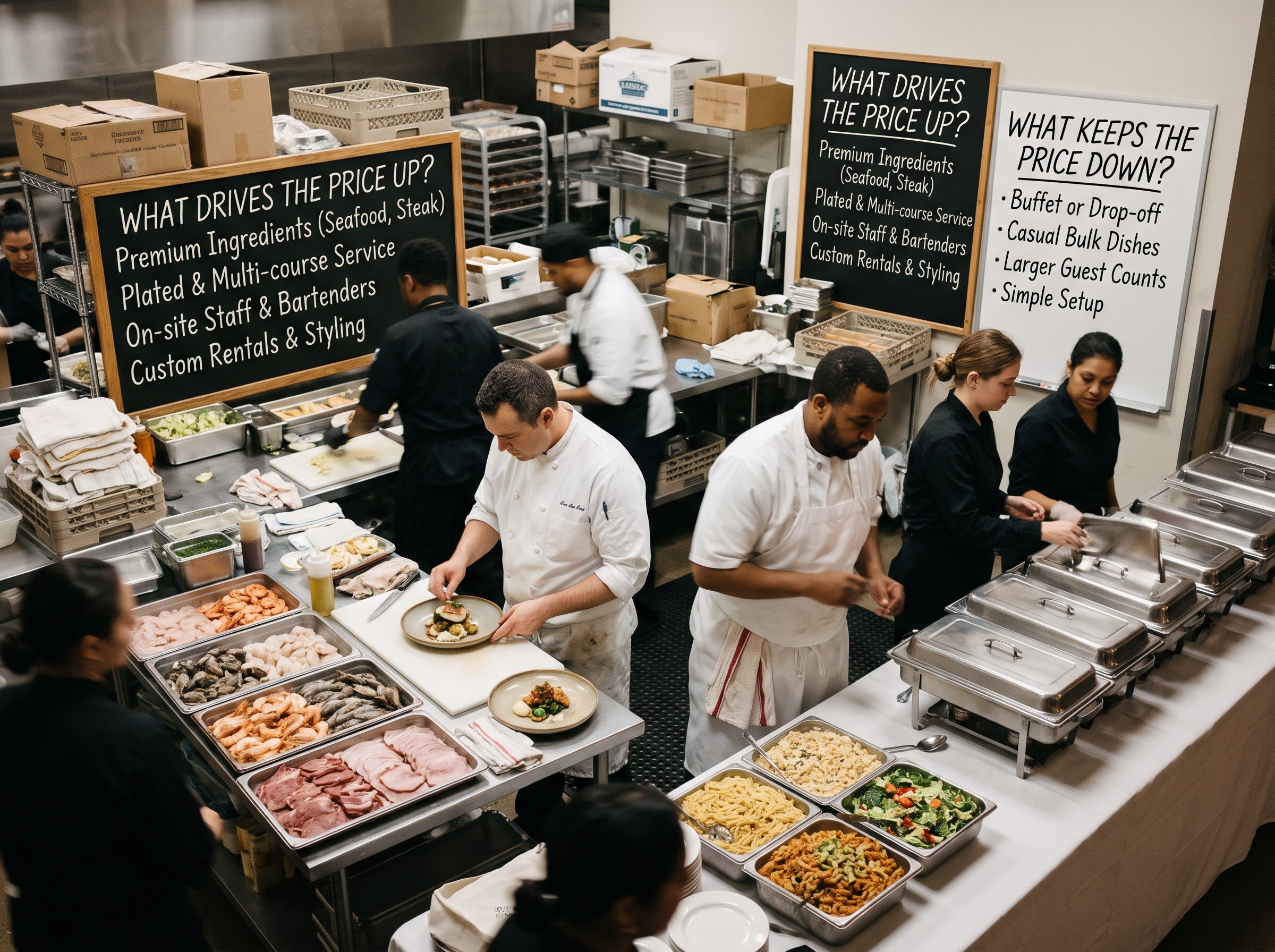
Fair question. I just can’t answer it in one sentence, and I’m suspicious of anyone who does. After years in catering sales, and a lot of quotes, I can tell you the per person number isn’t really a price. It’s what you get when you multiply a dozen decisions together, and you make most of those decisions yourself.
So here is how I’d explain it if you were in my office with a cup of coffee: what pushes the number up, what brings it down, and how to read a quote so the final invoice doesn’t surprise you.
Where the Catering Cost Per Person Usually Lands
Before we talk about drivers, let’s get some ground under our feet. National averages help as long as you treat them as a starting point and not a promise.
Wedding Catering Cost Per Person Benchmarks
Weddings have the best data because researchers study them the most. The Knot’s 2025 Real Weddings Study, which surveyed almost 17,000 US couples, put the average catering cost per person at $80, with regional averages ranging from $62 to $123. Midwest weddings came in lowest and Mid Atlantic weddings came in highest. Their newer study held steady: wedding catering averaged $80 per person in The Knot’s 2026 study of 10,474 couples married in 2025.
Other sources land lower, and that mostly comes down to what they count. Zola’s 2025 index puts average wedding catering at $6,927 nationwide, or roughly $46 to $55 per person, which works out to about 14% of the total wedding budget. When two reputable sources disagree by thirty dollars a head, they usually measure different things, like whether the figure includes bar service, staffing, or rentals. That’s also why the dishes you choose for your wedding buffet menu can matter less than what the quote quietly includes or leaves out.
Everyday and Corporate Events
Away from weddings, the range gets even wider. Thumbtack’s editors put catering anywhere from about $10 per guest at the low end to $150 or more per person at the high end. On the procurement side, IBISWorld gives a 2026 benchmark market price of $65 per person for catering services, with prices growing at a compound annual rate of 2.84% from 2023 to 2026. Business events follow their own logic around headcount, timing, and dietary needs, which we cover in depth in our guide to corporate event catering.
From where I sit, the honest summary is this: a simple delivered lunch might cost fifteen dollars a head, a solid wedding dinner might cost eighty, and a formal multicourse event in a big city can easily clear one fifty. What separates them is everything below.
Driver One: Service Style Moves Your Catering Cost Per Person More Than the Menu
If I could get every client to understand one thing, it would be this. How the food reaches the guest matters more than what the food is.
I’ve watched people agonize over salmon versus chicken to save four dollars a head and then pick a plated dinner that adds twenty. The menu is where people feel in control. Service style is where the real money is.
The Five Main Formats
Here’s how I’d describe the main formats, roughly from least to most expensive:
- Drop off catering. We cook, pack, deliver, and leave. You handle the setup and the cleanup. This is often the most cost effective option, averaging around $10 to $20 per person, and online catering ordering has made it easier than ever to set up.
- Buffet. Guests serve themselves, but you still need attendants to replenish, a captain to manage flow, and someone to break it all down. Fewer servers than plated, but not zero.
- Stations. Chef attended carving stations, pasta stations, raw bars. They look relaxed but often cost more than a buffet because each station needs its own staff and equipment.
- Family style. Platters at every table. Lovely for conversation, but you’re buying more food (every table needs a full set of every dish) and more serveware.
- Plated. A server sets a composed dish in front of every guest. This takes the most kitchen labor, the most floor staff, and the tightest timing.
What the Data Shows
For weddings, Zola reports formal plated dinners at $65 to $85 per person, buffet service at $40 to $65, family style at $50 to $70, and cocktail receptions at $35 to $55. Thumbtack’s general numbers show the same pattern even more starkly: a buffet or family style meal might run $25 per person while a formal plated meal could reach $145 per person. If you’re still weighing the two most common formats, our full breakdown of buffet vs plated dinner service walks through the tradeoffs beyond price.
The reason is labor, which brings me to the next driver.
Driver Two: How Labor Shapes Catering Cost Per Person
When a client pushes back on a quote, it’s almost never about the food. It’s about the staffing line, and I understand why. It feels abstract. You can picture a beef tenderloin. It’s harder to picture the dishwasher who’ll still be scrubbing sheet pans at midnight.
But here’s the reality of an off site event. I pay every server, bartender, chef, captain, and porter on your event for the full shift, and that includes travel, load in, setup, service, breakdown, and load out. A four hour reception often means a nine hour day for my team.
Staffing Ratios
Staffing ratios drive the number. For a plated dinner, I usually want one server for every ten to twelve guests, and more if there are wine pours or a tight program. For a buffet, I can stretch that ratio quite a bit. The bartender count depends on how complicated the drinks are. A beer and wine bar moves fast. A full cocktail menu with muddled drinks does not.
When someone asks me to “just cut a few servers,” I walk them through what that looks like. Slower courses. Cold food. Empty water glasses during the toasts. Sometimes that trade works for a casual party. For a wedding with a tight timeline, it rarely does.
Why Small Events Raise Catering Cost Per Person
Labor also explains why small events cost more per head. The minimum crew to run an event safely doesn’t shrink much from eighty guests to forty, but you split that cost across half as many people. Zola’s data points to this too, noting that small scale catering can push the per person cost up to $75 to $100.
Driver Three: Guest Count Works Both Ways
Most people assume a bigger guest list means a cheaper plate. Sometimes it does. Bulk purchasing helps, and a larger crowd spreads fixed costs like the kitchen setup and the delivery truck more thinly.
But it’s not linear. Bridebook notes that you might expect the cost per person to drop as the guest list grows, but that isn’t always true for wedding catering, because the venue, the number of kitchen and serving staff, and the dining format all influence the price. The Knot found something similar: there wasn’t a big difference in the average cost of wedding catering between weddings with smaller and larger guest lists.
What I tell clients is that the per person rate is only half the story. Your total bill is that rate times your headcount, and every guest you add brings extra costs that never show up in the food price. A planner at Woman Getting Married put it well: every person you cut saves 1.5 to 2 times the per plate cost once you factor in rentals, linens, and service staff. In my experience that’s accurate. Each guest needs a chair, a place setting, a share of the linen, and a share of a server’s attention. And once you have a firm number, knowing how much food per person for a buffet you really need keeps you from paying for trays nobody touches.
Driver Four: Ingredients, Location, and Catering Cost Per Person
Now we can talk about the food itself.
Protein and Complexity
Protein is the biggest swing. Chicken, pork, and vegetarian entrées sit at the bottom. Fish depends on the species and the season. Beef sits at the top, and beef has stayed especially expensive lately. USDA’s Economic Research Service listed beef and veal among the categories it expected to rise faster than their historical average in 2026, as Food Dive reported. ERS data presented at USDA’s Agricultural Outlook Forum showed that higher cattle prices have lifted retail beef prices, with cattle producers now receiving more than half of the retail beef dollar, up from about 37% in 2021. When a client insists on filet for two hundred people, I make sure they understand what that means for the quote.
Complexity counts too. Zola points out that simple, seasonal menus cost far less than elaborate dishes requiring specialty ingredients or complex preparation. My kitchen can prep a braised short rib the day before. A delicate fish that we have to sear to order for 150 guests needs more cooks on the line during service.
The Wider Food Economy
Catering lives in the “food away from home” category, and that category has climbed faster than groceries. Purdue’s agricultural economists reported that grocery prices rose 2.3% in 2025 while food away from home rose 4.0%. Looking ahead, ERS projected food away from home prices to rise 4.6% in 2026, compared with 1.7% for groceries, according to Food Business News. If you got a quote eighteen months ago and you’re comparing it to one today, that gap explains part of the difference.
Geography stacks on top of all this. Rent, wages, and delivery costs differ a lot between a small Midwestern city and Manhattan, and a caterer’s pricing reflects their own overhead. That’s why The Knot’s regional spread runs so wide.
Driver Five: The Bar Can Double Your Catering Cost Per Person
I’ve seen bar service match the food cost more times than I can count. Thumbtack notes that drinks greatly increase a catering budget, and an open bar can cost as much per person as the meal.
Common Bar Structures
You’ll usually see one of a few structures:
- Per person bar packages. A flat rate per guest per hour, usually tiered from beer and wine up to premium spirits. Easy to budget, and you know the number up front.
- Consumption billing. You pay for what the bartenders actually pour. This can save money with a light drinking crowd and cost you dearly with a heavy one.
- Host supplied alcohol. You buy the alcohol and we provide bartenders, glassware, ice, mixers, and the required insurance. Not every venue allows it, and many charge a corkage or service fee.
- Cash or limited bar. Guests pay, or you host only certain drinks or certain hours.
Smart Bar Savings
Some cost levers here deserve more attention. A signature cocktail plus beer and wine, instead of a full liquor bar, cuts both product and labor costs. Many hosts close the bar during dinner service and most guests don’t notice. Shortening the open bar window by an hour can save more than downgrading an entrée.
Thumbtack also reminds clients that caterers usually charge separately for alcohol, bartenders, and glassware rentals, and sales tax comes on top.
Driver Six: Rentals, Venues, and Catering Cost Per Person
The venue might be the most underestimated influence on your catering cost per person.
A hotel ballroom or an established event venue usually has tables, chairs, a working kitchen, and sometimes basic linens and china. A barn, a backyard, a rooftop, or a raw industrial space has none of that. My team has to rent, deliver, set, and pick up every fork, every chair, every warming cabinet, and sometimes a full field kitchen.
I’ve quoted events where the rental order cost more than the food. That isn’t the caterer padding the bill. It’s simply what it takes to turn an empty room into a restaurant for one night.
Venues can also restrict your catering choices. Many keep an exclusive or preferred caterer list, and that limits your negotiating room. In the UK, Bridebook’s 2026 data put the average external catering cost per head at £159 when couples had to use a required list, compared with £112.50 when they could choose freely. The details differ by market, but the principle carries over: fewer choices usually means higher prices.
Before you fall in love with a venue, ask what it includes, what kitchen access looks like, how late you can load out, and whether it charges an outside catering fee. Those answers will shape your catering quote as much as anything on the menu.
Driver Seven: Service Charges, Gratuity, and Tax
This is where most of the “surprise” on final invoices comes from, and it’s where I spend the most time with clients. It shouldn’t surprise anyone. The fine print just tends to bury it.
What a Service Charge Covers
Almost every full service caterer adds a service charge. Toast describes the catering service charge on large events as typically ranging from 18% to 25%, depending on the size, nature, and location of the event. Paychex explains that a catering service fee generally covers setup, service during the event, and cleanup.
The confusing part is that a service charge isn’t necessarily a tip. Under US federal tax and labor rules, a mandatory “automatic gratuity” counts as a service charge, and what makes something a true tip is whether the customer freely chooses to pay it and sets the amount, as Toast’s gratuity guide explains. The percentage alone doesn’t tell you whether the money goes to employees.
Tipping on Top
So you need to ask directly: does this service charge go to the staff, or does it cover the company’s operating costs? If it covers operating costs, guests customarily tip the crew separately. Toast’s catering tipping guide says it’s customary to add 15% to 20% of the total catering bill, though if you’ve already paid a service charge, tipping a little less than that is acceptable.
Sales Tax and the Real Total
Then there’s sales tax, which in many states applies to the service charge as well as the food. Add it all up and you can see why a quoted $80 per person can turn into well over $100 per person on the final bill. A wedding planner at Woman Getting Married said it plainly: the real cost is almost never the per person number on the initial quote, because the service charge, tax, vendor meals, rentals, and bar package all sit on top of it.
My advice is to budget around 30% to 35% above the base per person food rate until you’ve seen a fully itemized quote. Then you can relax.
Driver Eight: How Timing Affects Catering Cost Per Person
The calendar has more to do with price than most people realize.
Saturday evenings from May through October are the most competitive dates in catering. Caterers have limited kitchens, limited trucks, and limited experienced staff, so peak demand pushes up both pricing and minimums. Paperlust lists booking a Friday or Sunday slot and asking about off peak pricing as a top money saving tip. I agree completely. A Sunday brunch wedding or a Thursday evening corporate event can unlock better pricing, more flexible minimums, and sometimes a more senior team.
Time of day matters too. Breakfast and lunch menus naturally cost less than dinner. Guests eat less, they usually drink less, and the format tends to be simpler.
Lead time is the quiet one. Book early and you get your pick of dates and staff. Book three weeks out and you may pay rush fees, overtime, or premiums on rentals that are already scarce. Last minute changes to your guest count or menu can also trigger extra charges once we’ve finalized purchasing and scheduling. Tracking RSVPs with one of the best event planning apps helps you lock in a final count before the caterer’s deadline.
Driver Nine: The Extras That Creep In
Then there are the small lines that add up quietly:
- Cake cutting fees if your cake comes from an outside bakery.
- Vendor meals for your photographer, band, and planner.
- Late night snacks after the main meal.
- Coffee and dessert service as a separate station.
- Kids’ meals (usually cheaper, but still a line).
- Special dietary plates for allergies, which often need separate prep space and attention.
- Tastings, which some caterers credit back if you book and some don’t.
- Delivery and travel fees for venues outside the caterer’s normal area.
- Overtime if your event runs long.
None of these are unreasonable. They just need to appear on the quote so nothing catches you off guard.
How to Lower Your Catering Cost Per Person Without Ruining the Event
I’d rather help a client find a smart compromise than lose them to a cheaper quote that cuts corners where it shows.
Cuts That Actually Work
Here’s what I actually recommend when someone needs to trim:
- Pick the service style first, then build the menu around it. If a plated dinner doesn’t fit the budget, a well run buffet or stations format can feel just as generous, especially with a few creative buffet catering ideas on the table.
- Trim the guest list before you trim the quality. It’s the most powerful lever you have, and it saves money across every vendor, not just catering.
- Lean into seasonal produce and smart proteins. A beautifully cooked chicken thigh with seasonal vegetables beats an overcooked steak every time.
- Shorten the cocktail hour or reduce passed appetizers. Four or five varieties are plenty. Twelve is a menu nobody remembers.
- Simplify the bar. A signature drink, beer, and wine will satisfy most crowds.
- Choose off peak dates and times. Friday, Sunday, or a weekday brunch can make a real difference.
- Pick a venue that brings its own infrastructure. Tables, chairs, and a real kitchen save a surprising amount.
- Ask what the caterer does best. Every kitchen has dishes it can execute brilliantly at volume, and those usually cost less to produce.
Cuts I Talk Clients Out Of
What I discourage is cutting staff below a safe level, skipping the kitchen setup a venue needs, or choosing a caterer who can’t show proper licensing and insurance. Those savings tend to come back later as problems.
How to Read a Catering Quote Like a Pro
When you have two or three quotes side by side, don’t compare the headline per person number. Compare the totals, line by line. If you’re still narrowing down vendors, start with our guide on how to choose a caterer, then come back to this checklist. Here’s what I’d check:
- Does the per person rate cover food only, or does it include staff, rentals, and bar?
- How many staff does the quote list, for how many hours, and at what rate?
- What percentage is the service charge, what does it cover, and does any of it go to staff?
- Does the caterer charge tax on the service charge?
- What are the guest count minimum and the final count deadline?
- What is the deposit, the payment schedule, and the cancellation policy?
- Who supplies linens, china, glassware, and flatware, and does the price include them?
Zola warns that catering quotes vary wildly because different vendors include different services, and that knowing what’s typically included helps you compare accurately and avoid surprise costs. I’ve seen a quote that looked $20 per person cheaper end up $5 more expensive once the client added staffing and rentals. The cheapest headline doesn’t always mean the cheapest event.
A good caterer will happily walk you through every line. If someone can’t or won’t explain where your money goes, that tells you something.
The Bottom Line on Catering Cost Per Person
Your catering cost per person comes down to a series of decisions: how you serve the food, how many people serve it, what goes on the plate, where the event happens, when it happens, and what the bar pours. The menu gets the attention, but service style, labor, venue, and fees usually move the number the most.
If you remember one thing, make it this: talk to your caterer about your total budget early, not just your per person target. When I know the real number, I can build an event that fits it. When I only know the per person number, we both end up chasing surprises.
FAQ: Catering Cost Per Person
What is the average catering cost per person?
It depends on the event type and service style. For weddings, The Knot’s study puts the average at $80 per person, while general event catering covers a much wider range. You can see more detail in Thumbtack’s catering cost guide.
Is a buffet always cheaper than a plated dinner?
Usually, because it needs fewer servers, though a buffet sometimes needs more food to avoid running out. Zola’s wedding catering cost breakdown compares the major service styles side by side.
Why is my final catering bill higher than the per person quote?
Caterers often add service charges, sales tax, rentals, bar service, and staff gratuity on top of the base rate. Toast’s explanation of service charges versus tips clarifies what those charges usually cover.
Do I need to tip if there’s already a service charge?
Ask whether the service charge goes to the staff. If it doesn’t, tipping 15% to 20% is customary. Toast’s catering tipping guide covers the etiquette in detail.
Does a smaller guest count lower the cost per person?
Not necessarily. Fewer guests share the same minimum staffing and setup costs, which can raise the per head price. Bridebook’s catering cost guide explains why per person pricing doesn’t always fall as guest lists grow.
Why have catering prices gone up recently?
Restaurant and food service prices have risen faster than grocery prices, with beef among the fastest climbers. Food Business News’ report on the USDA food price outlook breaks down the latest projections.
How do I lower my catering cost per person?
Choose a simpler service style, trim the guest list, book off peak dates, keep the bar simple, and pick a venue with its own kitchen and furniture. Paperlust’s wedding catering guide offers more practical savings ideas.
References
- The Knot: The Average Wedding Catering Cost
- Zola: Wedding Catering Costs, Real Numbers and Budget Tips
- Thumbtack: How Much Does Catering Cost?
- Thumbtack: How Much Should Catering Cost Per Person?
- IBISWorld: Catering Services Procurement Pricing
- Bridebook: How Much Does Wedding Catering Cost? (UK 2026)
- Bridebook: How Much Does Wedding Catering Cost? (2025 Average)
- Stacker: Corporate Catering Value Guide
- Food Business News: Food Prices Projected to Plateau
- Food Dive: USDA Food at Home Price Forecast for 2026
- Purdue University: Food Prices 2026
- Toast: Service Charge vs. Tip
- Toast: Gratuity vs. Tip
- Toast: How Much to Tip for Catering
- Paychex: Tax on Gratuity vs. Service Charge
- Paperlust: How Much Does Wedding Catering Cost? (2026 Guide)
- Woman Getting Married: Wedding Catering Costs Around the Country
Leave a Reply